
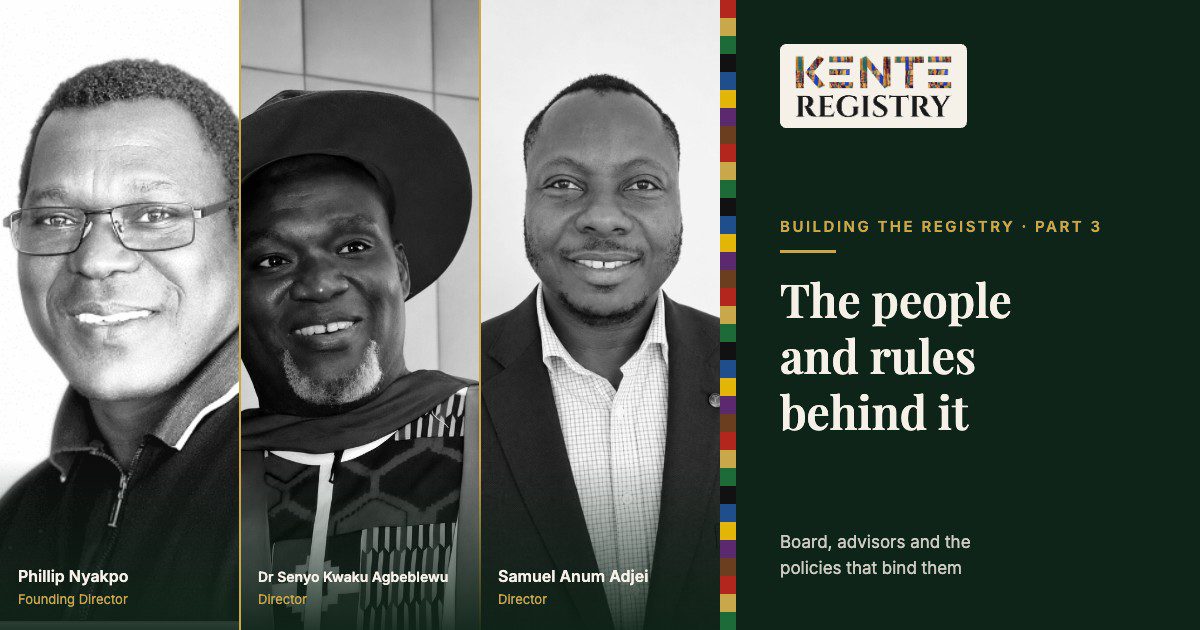
Building the Registry · Part 3 of 3
A Registry record is meant to last. Once a weaver’s name and work are entered under a permanent identifier, people will rely on that record long after the day it was made: the weaver’s family, buyers, researchers and museums. That raises a question every reader is entitled to ask. Who decides what goes into the record, and what stops them from bending it?
In part 1, I described how the Registry became a company. In part 2, I explained what it means that the company is now a registered charity. This final part is about the people who are accountable for the Registry, and the rules they have agreed to be bound by.
The board
Kente Registry Limited is governed by a board of three Directors. They serve without payment and are accountable to the company’s members for how the Registry is run.
- Phillip Nyakpo, Founder, Founding Director and Company Secretary. I am a journalist, author and podcaster, and I wrote the Registry’s founding Standard.
- Dr Senyo Kwaku Agbeblewu, Director. An entrepreneurship scholar whose doctoral research at Edith Cowan University looks at why people choose to contribute to shared systems, and what quietly stops them.
- Samuel Anum Adjei, Director. An accountant and auditor (ACCA, CPA Australia) with experience in public sector audit, who brings the discipline of records that can be checked.
As Founding Director, I have no extra vote and no veto. The Constitution also requires most of the Directors to be unrelated to one another and to have no financial interest in any supplier to the company.
The advisors
The board is supported by Advisors, who give expert counsel in their fields but hold no governance role. Among them are:
- Dr Julius A. Nukpezah, Governance and Public Finance Advisor. An Associate Professor of Public Policy and Administration at Mississippi State University, and a former Senior Policy Advisor at Ghana’s Ministry of Food and Agriculture.
- Martin Hiles, Advisor for Ghanaian Development and Partnerships. A British development and logistics professional with many years in Ghana, and a former Managing Director of the Volta Lake Transport Company.
The rules we follow
The company is governed by two published documents. The first is its Constitution, adopted on 13 September 2026, which I described in part 1. The second is the Conflict of Interest Policy, which the Directors adopted on 10 October 2026.
Most conflict of interest policies are written for boardrooms. Ours had to be written for weaving towns as well. A Registry record carries reputational and commercial value for the weaver named in it, so the risks are specific to our work: a field officer recording a relative, a gift offered in return for a record, a local office-holder with a stake in which weavers are recorded first.
The policy applies to everyone who takes part in the Registry’s work, in Australia, in Ghana and anywhere else in the world: Directors, Advisors, members of any committee or council, and the field officers who document weavers. Its main requirements are simple:
- Disclose. Everyone in scope declares their interests every year, even when they have nothing to declare. Field officers confirm in writing, for each weaver or cloth they record, whether they have any connection to it. People outside Australia can disclose by email, by WhatsApp or by telephone.
- Step aside. A person with an interest in a record does not assess, verify or approve it. Someone with no interest does that instead, and the step taken stays attached to the submission permanently.
- Take nothing. No one may ask for or accept money, cloth or any other benefit in connection with a submission or a Registry decision. Gifts valued above fifty Australian dollars must be declined, or, where refusing would cause serious offence, accepted on behalf of the company and recorded.
- Keep a record. The Company Secretary keeps a Register of Interests for everyone in scope, wherever they are, and the board reviews it at least once a year.
One choice in the policy deserves explaining. It does not stop a field officer’s own family or lineage from being documented. In a weaving town, nearly everyone is related to a weaver, and a blanket ban would shut out the very communities the Registry exists to record. Instead, the officer declares the tie and someone else makes the decision. We think that is both fairer and more honest.
What comes next
Governance is never finished. Within eighteen months of its founding, the company must establish a Cultural Advisory Council that brings weavers, weavers’ associations and traditional authorities into the Registry’s work, drawn as far as practicable from both the Ewe and Asante weaving traditions. The Constitution also creates a class of Weaver Members, so the weavers whose work we document can have a vote in how the company is run. The board must keep a written succession plan, and the Conflict of Interest Policy will be reviewed at least every two years.
Each year, the company will also report to the ACNC on its activities and finances, and those reports will appear on its public listing.
Thank you
I am grateful to Senyo and Samuel for taking on the duties of directors, and to Julius and Martin for giving their time and experience as advisors. Together they have turned a personal project into an institution that answers to others.
That is the point of everything in this series. A record kept “for all time” should not rest on trust in one person. It should rest on rules that anyone can read, people who can be held to account, and a regulator who checks. Those things are now in place, and the Registry’s work with weavers carries on.
Phillip Nyakpo is the founder of Kente Registry and a Director of Kente Registry Limited.