
Category: Registry News

News about Kente Registry Limited: its establishment, governance and milestones.

  • The People and Rules Behind the Kente Registry

    The People and Rules Behind the Kente Registry

    Building the Registry · Part 3 of 3

    A Registry record is meant to last. Once a weaver’s name and work are entered under a permanent identifier, people will rely on that record long after the day it was made: the weaver’s family, buyers, researchers and museums. That raises a question every reader is entitled to ask. Who decides what goes into the record, and what stops them from bending it?

    In part 1, I described how the Registry became a company. In part 2, I explained what it means that the company is now a registered charity. This final part is about the people who are accountable for the Registry, and the rules they have agreed to be bound by.

    The board

    Kente Registry Limited is governed by a board of three Directors. They serve without payment and are accountable to the company’s members for how the Registry is run.

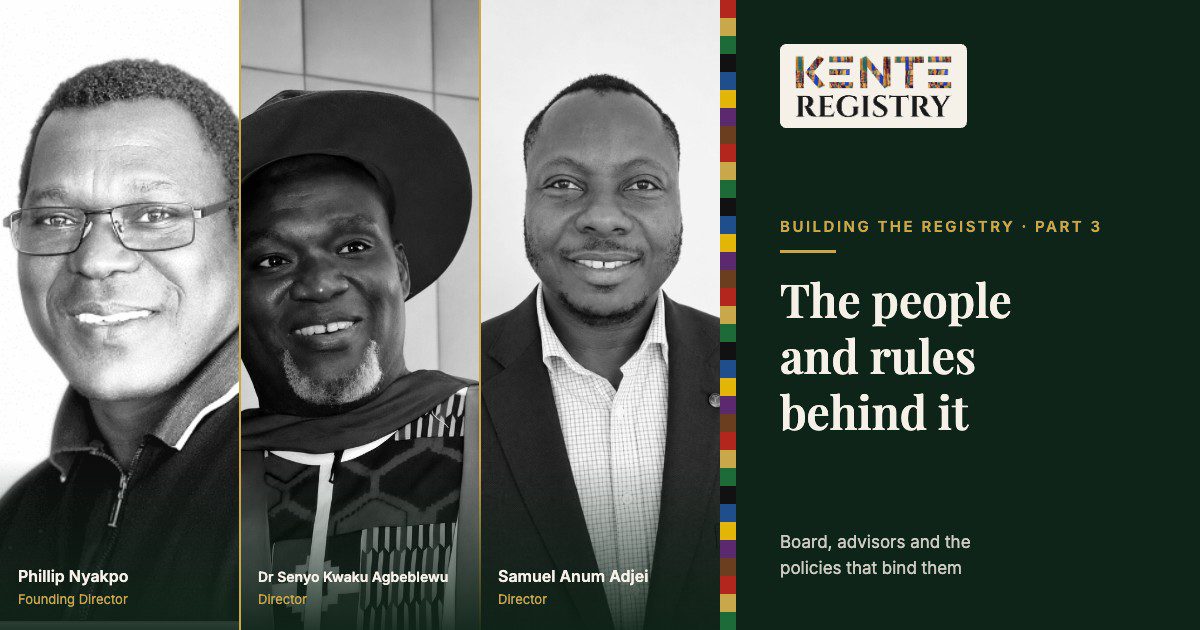
    • Phillip Nyakpo, Founder, Founding Director and Company Secretary. I am a journalist, author and podcaster, and I wrote the Registry’s founding Standard.
    • Dr Senyo Kwaku Agbeblewu, Director. An entrepreneurship scholar whose doctoral research at Edith Cowan University looks at why people choose to contribute to shared systems, and what quietly stops them.
    • Samuel Anum Adjei, Director. An accountant and auditor (ACCA, CPA Australia) with experience in public sector audit, who brings the discipline of records that can be checked.

    As Founding Director, I have no extra vote and no veto. The Constitution also requires most of the Directors to be unrelated to one another and to have no financial interest in any supplier to the company.

    The advisors

    The board is supported by Advisors, who give expert counsel in their fields but hold no governance role. Among them are:

    • Dr Julius A. Nukpezah, Governance and Public Finance Advisor. An Associate Professor of Public Policy and Administration at Mississippi State University, and a former Senior Policy Advisor at Ghana’s Ministry of Food and Agriculture.
    • Martin Hiles, Advisor for Ghanaian Development and Partnerships. A British development and logistics professional with many years in Ghana, and a former Managing Director of the Volta Lake Transport Company.

    The rules we follow

    The company is governed by two published documents. The first is its Constitution, adopted on 13 September 2026, which I described in part 1. The second is the Conflict of Interest Policy, which the Directors adopted on 10 October 2026.

    Most conflict of interest policies are written for boardrooms. Ours had to be written for weaving towns as well. A Registry record carries reputational and commercial value for the weaver named in it, so the risks are specific to our work: a field officer recording a relative, a gift offered in return for a record, a local office-holder with a stake in which weavers are recorded first.

    The policy applies to everyone who takes part in the Registry’s work, in Australia, in Ghana and anywhere else in the world: Directors, Advisors, members of any committee or council, and the field officers who document weavers. Its main requirements are simple:

    • Disclose. Everyone in scope declares their interests every year, even when they have nothing to declare. Field officers confirm in writing, for each weaver or cloth they record, whether they have any connection to it. People outside Australia can disclose by email, by WhatsApp or by telephone.
    • Step aside. A person with an interest in a record does not assess, verify or approve it. Someone with no interest does that instead, and the step taken stays attached to the submission permanently.
    • Take nothing. No one may ask for or accept money, cloth or any other benefit in connection with a submission or a Registry decision. Gifts valued above fifty Australian dollars must be declined, or, where refusing would cause serious offence, accepted on behalf of the company and recorded.
    • Keep a record. The Company Secretary keeps a Register of Interests for everyone in scope, wherever they are, and the board reviews it at least once a year.

    One choice in the policy deserves explaining. It does not stop a field officer’s own family or lineage from being documented. In a weaving town, nearly everyone is related to a weaver, and a blanket ban would shut out the very communities the Registry exists to record. Instead, the officer declares the tie and someone else makes the decision. We think that is both fairer and more honest.

    What comes next

    Governance is never finished. Within eighteen months of its founding, the company must establish a Cultural Advisory Council that brings weavers, weavers’ associations and traditional authorities into the Registry’s work, drawn as far as practicable from both the Ewe and Asante weaving traditions. The Constitution also creates a class of Weaver Members, so the weavers whose work we document can have a vote in how the company is run. The board must keep a written succession plan, and the Conflict of Interest Policy will be reviewed at least every two years.

    Each year, the company will also report to the ACNC on its activities and finances, and those reports will appear on its public listing.

    Thank you

    I am grateful to Senyo and Samuel for taking on the duties of directors, and to Julius and Martin for giving their time and experience as advisors. Together they have turned a personal project into an institution that answers to others.

    That is the point of everything in this series. A record kept “for all time” should not rest on trust in one person. It should rest on rules that anyone can read, people who can be held to account, and a regulator who checks. Those things are now in place, and the Registry’s work with weavers carries on.

    Phillip Nyakpo is the founder of Kente Registry and a Director of Kente Registry Limited.
  • Kente Registry Limited Is Now a Registered Charity

    Kente Registry Limited Is Now a Registered Charity

    Building the Registry · Part 2 of 3

    On 13 October 2026, the Australian Charities and Not-for-profits Commission confirmed that Kente Registry Limited is a registered charity. The registration is backdated to 14 September 2026, the day the company itself was registered. In law, Kente Registry Limited has been a charity for every day of its life as a company.

    In part 1 of this series, I wrote about how the Registry became a company with a constitution, a board and members. This part is about what the charity decision means, for the weavers whose names the Registry keeps and for anyone who relies on its records.

    What the ACNC decided

    The ACNC is Australia’s national regulator of charities. Before it registers an organisation, it examines what the organisation is set up to do and how it is governed, and decides whether its purposes are charitable in law and whether it is genuinely not-for-profit.

    The ACNC registered Kente Registry Limited under two charity subtypes: advancing culture and advancing education. Put plainly, the regulator has accepted that documenting Kente weavers, their communities and their cloth, and making that record available to the public, is work done for the public good.

    Why it matters for weavers

    A weaver who agrees to be recorded is trusting us with their name, their story and their work. That trust deserves more than a promise from me. Charity registration places the Registry inside a public system of accountability that does not depend on any one person’s good intentions.

    As a registered charity, the company must:

    • pursue only its charitable purposes, and use any income or surplus for those purposes, never for the private benefit of its directors or members;
    • meet the ACNC’s governance standards, which cover how the board makes decisions, manages conflicts of interest and stays accountable to its members;
    • report to the ACNC every year on its activities and finances; and
    • keep its details up to date on the public Charity Register, where anyone in the world can look it up.

    Those obligations sit alongside the commitments in our Constitution: that the Registry acts as a steward of Kente heritage and never as its owner, that it seeks each weaver’s free, prior and informed consent, and that its records stay open to the public. The Constitution sets out what we have promised. Charity registration means an independent regulator now watches whether we keep those promises.

    How you can check

    You don’t have to take our word for any of this. Kente Registry Limited’s entry on the Charity Register shows its charity status, its subtypes, its responsible people and, in time, the annual reports it files. View Kente Registry Limited on the ACNC Charity Register.

    You will now also see the ACNC Registered Charity Tick across this website. Each Tick links straight to that public listing, so anyone can confirm our status in a single click.

    What it does not mean, yet

    I want to be clear about the limits. Charity registration is not the same as being able to receive tax-deductible donations. That requires a separate endorsement from the Australian Taxation Office as a deductible gift recipient, which the company does not yet hold and will apply for in its own right. Until then, gifts to Kente Registry Limited are not tax deductible in Australia. The company does, however, now hold the tax concessions available to charities. On 21 October 2026, the Australian Taxation Office confirmed that Kente Registry Limited is endorsed for income tax exemption, GST concessions and the fringe benefits tax rebate, all effective from 14 September 2026.

    Charity status also does not change what the Registry is. We document weavers and their cloth, with their consent, and we attribute every record to its weaver, community and tradition. Registration recognises that work. It does not turn the Registry into an authority over who may weave Kente, or over Kente itself, which belongs to the weavers and communities of Ghana.

    Thank you

    I am grateful to my fellow directors, Samuel Anum Adjei and Dr Senyo Kwaku Agbeblewu, to our advisors, Dr Julius A. Nukpezah and Martin Hiles, and to everyone who helped prepare the application. Most of all, I am grateful to the weavers and field officers in Ghana. Their trust is the reason this work deserves the protection of charity law.

    A charity is only as trustworthy as the people who run it and the rules they follow. In the final part of this series, I will introduce the board and advisors behind the Registry, and the policies we have adopted to govern ourselves.

    Read Part 3: The People and Rules Behind the Kente Registry →

    Phillip Nyakpo is the founder of Kente Registry and a Director of Kente Registry Limited.
  • Kente Registry Limited Is Founded: The Registry Becomes an Institution

    Kente Registry Limited Is Founded: The Registry Becomes an Institution

    Building the Registry · Part 1 of 3

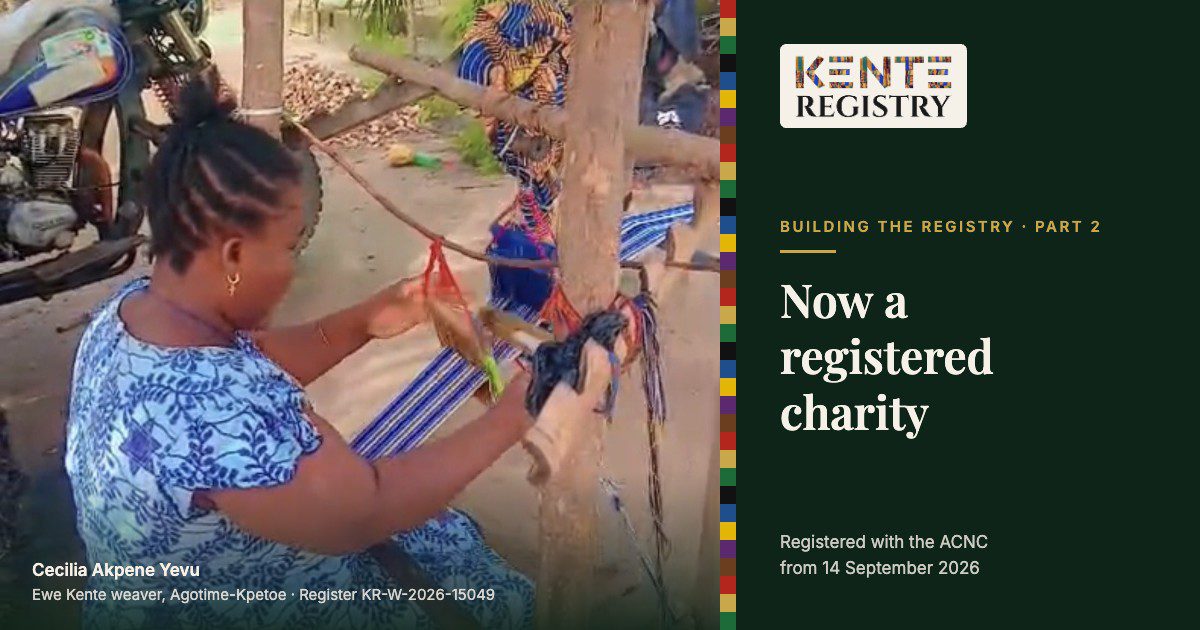
    In Agotime-Kpetoe, Cecilia Akpene Yevu weaves without her sight. A design she named after herself, Cecilia Yevu Kente, is now woven by other weavers too. For most of Kente’s history, a weaver like Cecilia would have left no written trace. Her cloth would travel, admired and copied, and her name would stay behind.

    Today she has a permanent record in the Kente Registry, KR-W-2026-15049, in her own name. Records like hers are why the Registry exists. Last month, the work of keeping them took on a new and more lasting form.

    From a project to an institution

    On 13 September 2026, the Registry’s three founding members, Samuel Anum Adjei, Dr Senyo Kwaku Agbeblewu and I, met by video conference and unanimously adopted a constitution. The next day, 14 September, Kente Registry Limited was registered in Western Australia as a public company limited by guarantee, with Australian Company Number 702 314 967.

    A company limited by guarantee has no shareholders and pays no dividends. Its members guarantee a small sum, in our case twenty dollars, should it ever be wound up, and any surplus it earns must go back into its purposes. It is the usual form for an Australian organisation that intends to serve the public rather than to make money for its owners.

    For the Registry, the change matters for a simple reason. Until September, this work rested on one person. A register meant to keep weavers’ names “for all time” cannot depend on the energy or the lifetime of its founder. It needs a body that outlasts any one of us, with a board, members, rules and records. That body now exists.

    What the Constitution protects

    We wrote our commitments to weavers into the Constitution itself, so that no future board can quietly set them aside. It requires the company to:

    • document Kente heritage as a steward, not an owner, and never claim ownership of traditional designs or motifs;
    • seek a weaver’s free, prior and informed consent before documenting them, and honour any withdrawal of that consent;
    • attribute every record to its weaver, community and tradition;
    • never sell or transfer weavers’ personal information; and
    • keep the Registry’s records open to the public, with permanent identifiers that are never reassigned, and never sell them or take them out of public access.

    Membership is free. Alongside ordinary members, the Constitution creates a class of Weaver Members, for the weavers and weaving households whose work the Registry documents, with the same right to vote. Directors serve without payment. My own role as Founding Director carries no extra vote or veto, and the board must keep a written succession plan so that the Registry’s records, systems and relationships never depend on a single person. Within eighteen months, the company must also establish a Cultural Advisory Council that brings in weavers, weavers’ associations and traditional authorities from the communities we document.

    The full text is published on this site: read the Constitution of Kente Registry Limited.

    The founding record

    On 15 September, the day after registration, I prepared a report for my fellow directors recording how the company was established: its registration details, its officeholders, the steps completed and the position of our application to become a charity. We have published a public edition of that report, updated this week to record what happened next. Read the Directors’ Report and Company Record (PDF).

    I am grateful to Samuel and Senyo, who said yes to the hard and unglamorous work of governance before there was anything to show for it, and to the weavers and field officers in Ghana whose trust gives the Registry its purpose.

    Becoming a company was the first step. A month later came news that changes how the Registry stands in public, and I will share it in the next part of this series.

    Read Part 2: Kente Registry Limited Is Now a Registered Charity →

    Phillip Nyakpo is the founder of Kente Registry and a Director of Kente Registry Limited.