
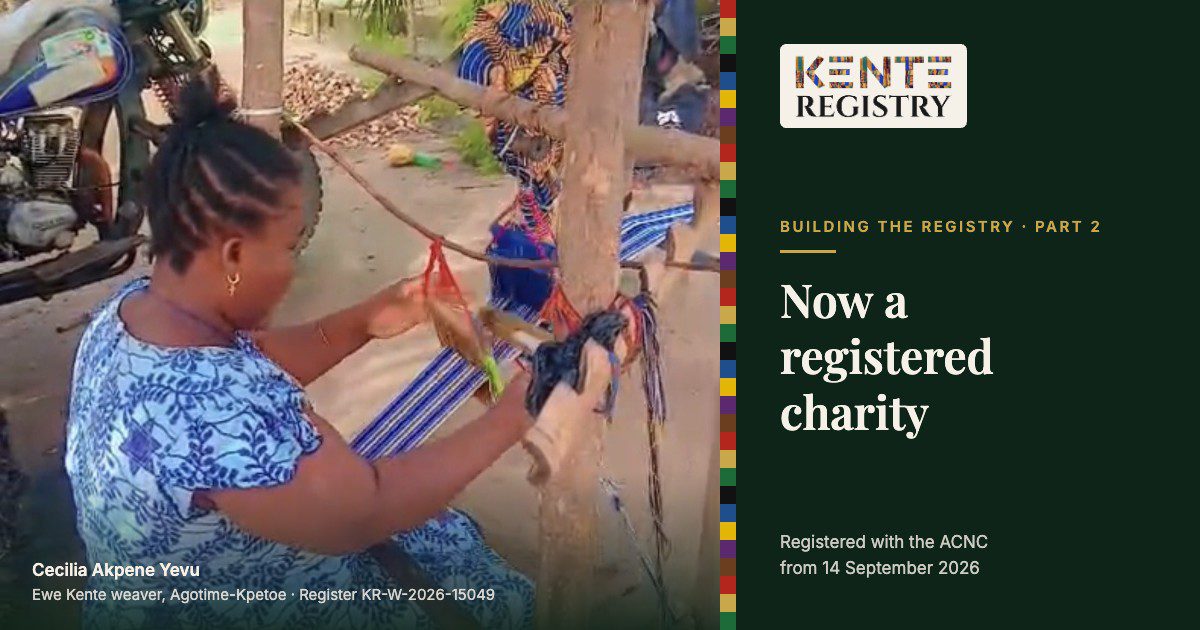
Building the Registry · Part 2 of 3
On 13 October 2026, the Australian Charities and Not-for-profits Commission confirmed that Kente Registry Limited is a registered charity. The registration is backdated to 14 September 2026, the day the company itself was registered. In law, Kente Registry Limited has been a charity for every day of its life as a company.
In part 1 of this series, I wrote about how the Registry became a company with a constitution, a board and members. This part is about what the charity decision means, for the weavers whose names the Registry keeps and for anyone who relies on its records.
What the ACNC decided
The ACNC is Australia’s national regulator of charities. Before it registers an organisation, it examines what the organisation is set up to do and how it is governed, and decides whether its purposes are charitable in law and whether it is genuinely not-for-profit.
The ACNC registered Kente Registry Limited under two charity subtypes: advancing culture and advancing education. Put plainly, the regulator has accepted that documenting Kente weavers, their communities and their cloth, and making that record available to the public, is work done for the public good.
Why it matters for weavers
A weaver who agrees to be recorded is trusting us with their name, their story and their work. That trust deserves more than a promise from me. Charity registration places the Registry inside a public system of accountability that does not depend on any one person’s good intentions.
As a registered charity, the company must:
- pursue only its charitable purposes, and use any income or surplus for those purposes, never for the private benefit of its directors or members;
- meet the ACNC’s governance standards, which cover how the board makes decisions, manages conflicts of interest and stays accountable to its members;
- report to the ACNC every year on its activities and finances; and
- keep its details up to date on the public Charity Register, where anyone in the world can look it up.
Those obligations sit alongside the commitments in our Constitution: that the Registry acts as a steward of Kente heritage and never as its owner, that it seeks each weaver’s free, prior and informed consent, and that its records stay open to the public. The Constitution sets out what we have promised. Charity registration means an independent regulator now watches whether we keep those promises.
How you can check
You don’t have to take our word for any of this. Kente Registry Limited’s entry on the Charity Register shows its charity status, its subtypes, its responsible people and, in time, the annual reports it files. View Kente Registry Limited on the ACNC Charity Register.
You will now also see the ACNC Registered Charity Tick across this website. Each Tick links straight to that public listing, so anyone can confirm our status in a single click.
What it does not mean, yet
I want to be clear about the limits. Charity registration is not the same as being able to receive tax-deductible donations. That requires a separate endorsement from the Australian Taxation Office as a deductible gift recipient, which the company does not yet hold and will apply for in its own right. Until then, gifts to Kente Registry Limited are not tax deductible in Australia. The company does, however, now hold the tax concessions available to charities. On 21 October 2026, the Australian Taxation Office confirmed that Kente Registry Limited is endorsed for income tax exemption, GST concessions and the fringe benefits tax rebate, all effective from 14 September 2026.
Charity status also does not change what the Registry is. We document weavers and their cloth, with their consent, and we attribute every record to its weaver, community and tradition. Registration recognises that work. It does not turn the Registry into an authority over who may weave Kente, or over Kente itself, which belongs to the weavers and communities of Ghana.
Thank you
I am grateful to my fellow directors, Samuel Anum Adjei and Dr Senyo Kwaku Agbeblewu, to our advisors, Dr Julius A. Nukpezah and Martin Hiles, and to everyone who helped prepare the application. Most of all, I am grateful to the weavers and field officers in Ghana. Their trust is the reason this work deserves the protection of charity law.
A charity is only as trustworthy as the people who run it and the rules they follow. In the final part of this series, I will introduce the board and advisors behind the Registry, and the policies we have adopted to govern ourselves.
Read Part 3: The People and Rules Behind the Kente Registry →
Phillip Nyakpo is the founder of Kente Registry and a Director of Kente Registry Limited.