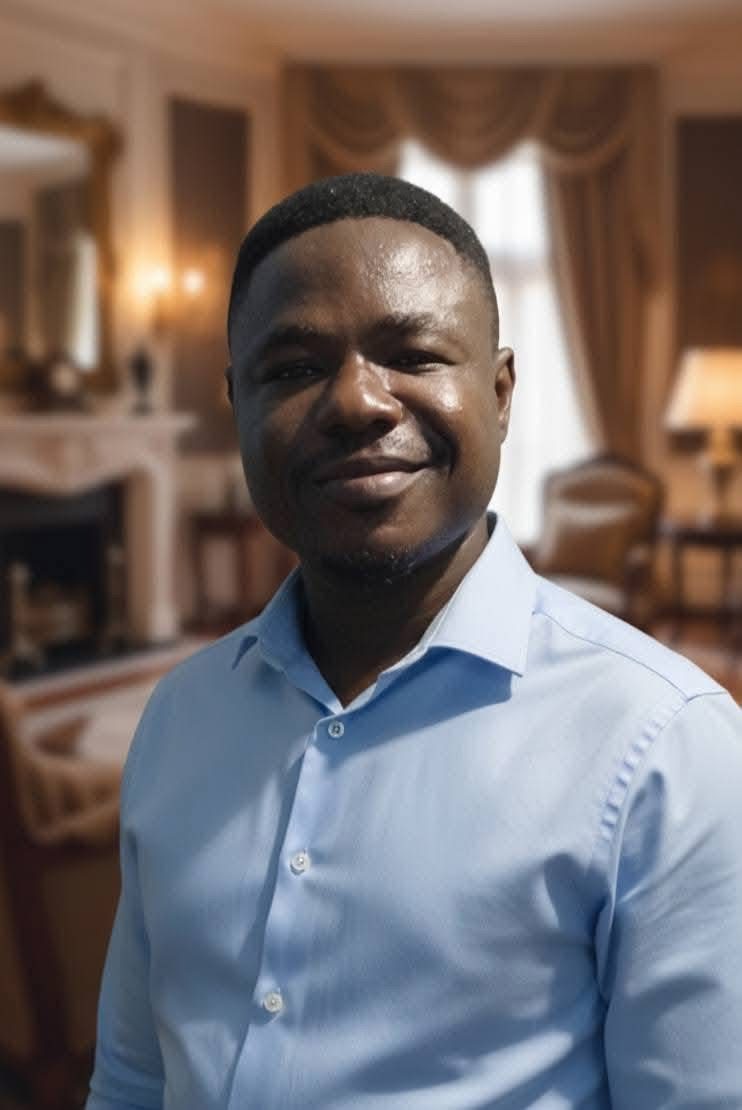
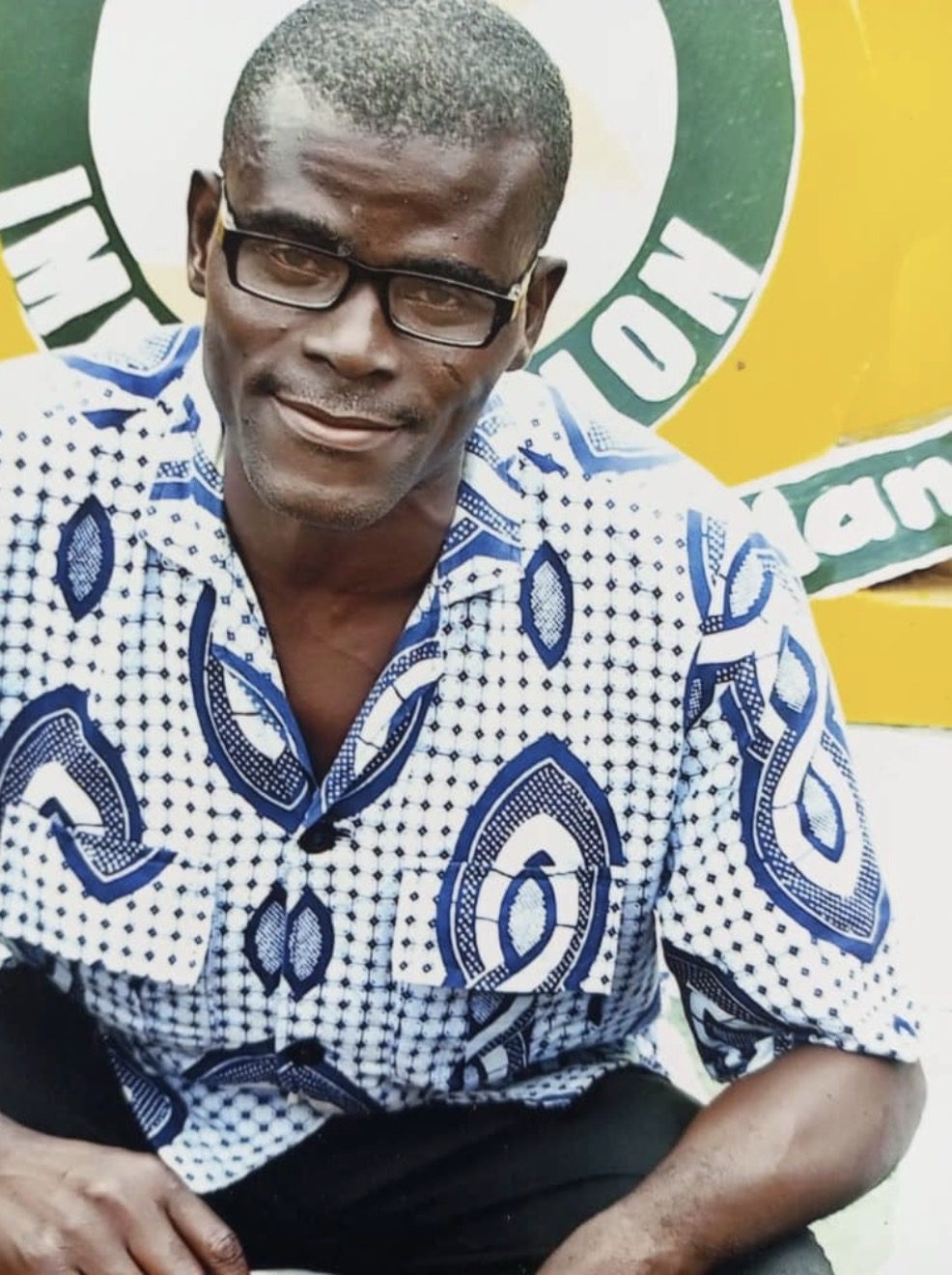
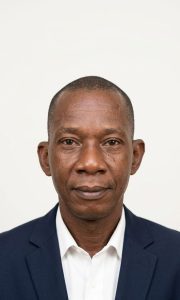
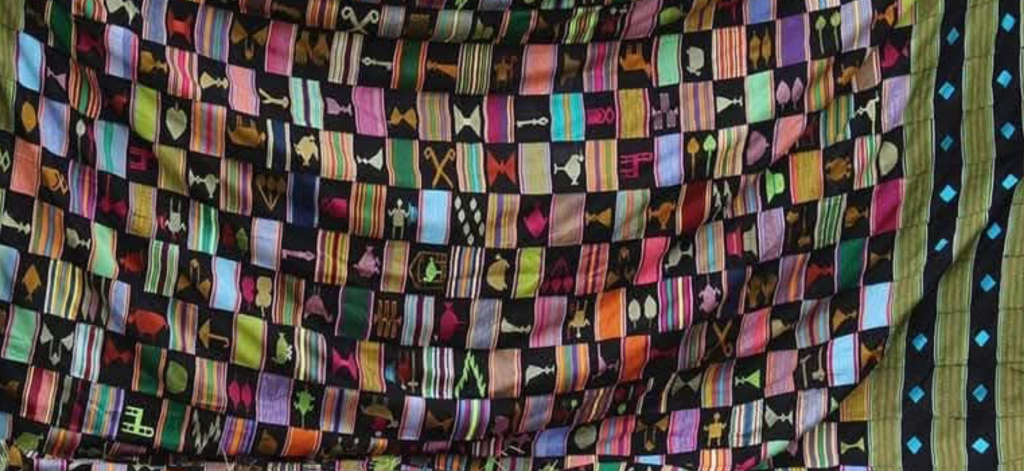
Self-taught through communal observation in Agotime-Kpetoe, learning from numerous weavers throughout the community rather than a single master.
Provenance
Verified · GI 2025
Foster Ahiagba is a Kente weaver from Agotime-Kpetoe, a historic centre of Ewe Kente weaving in Ghana’s Volta Region. Born in May 1979, he belongs to the Ewe cultural tradition and works within the Agbamevo, or Kete, weaving lineage that has defined Agotime for generations.
Early Life
Foster grew up in a community where weaving forms an integral part of cultural identity and daily life. From childhood he was surrounded by experienced weavers working on traditional looms throughout the town. Watching these artisans create vibrant and intricate Kete cloths inspired him to develop a deep appreciation for the craft.
Training and Learning Method
Unlike many traditional apprenticeships where a student trains under a single master, Foster Ahiagba learned through a communal observation method that is common in Agotime-Kpetoe. He did not train under one specific master weaver. Instead, he learned by observing numerous weavers throughout the community and practising what he saw.
We the people of Agotime are born with this craft; we do not always learn it formally. Anytime we approach someone who is weaving, we spend time watching. When the person leaves to take a rest, we enter the loom and practise what we have observed. So we learn from many people, not just one person. For example, we go to different houses where people are weaving, and within a few days we start doing it for ourselves.
Foster Ahiagba
Through repeated observation and practice, he gradually developed the technical skill and artistic confidence required to weave independently.
Weaving Practice
Foster Ahiagba specialises in the weaving of Ewe Kente, known locally as Agbamevo or Kete. His work follows the long-standing weaving traditions of the Agotime people, an inheritance that carries the stories, values, and historical memory of his community.
Signature Design: Denukudenu
Foster identifies Denukudenu as one of his signature or speciality designs.
Cultural Perspective
Foster Ahiagba views Kente weaving as a responsibility passed down from the ancestors. Each pattern and colour combination represents elements of Ewe cultural expression and identity. He believes that preserving and promoting Kente weaving is essential for maintaining the cultural heritage of the Agotime people. Through his work, he aims to ensure that younger generations appreciate and continue the tradition.
Current Activity
Foster Ahiagba continues to weave Kete cloth in Agotime-Kpetoe and contributes to the preservation and promotion of Ewe Kente weaving. His work helps sustain one of West Africa’s most recognised textile traditions while sharing its beauty with audiences within Ghana and internationally.
Interview record: Documented through field interview with Foster Ahiagba, conducted by Kente Registry Field Researcher Raymond Ayitey in Agotime-Kpetoe, Volta Region, Ghana. Part of the Kente Registry Documentation Initiative.
Workshop of Master Weaver Gator Gbogbo, Agotime-Kpetoe
Status Note: Documentation of this cloth is ongoing. The date of weaving is recorded by the artisan as falling within the early years of Ghana’s Fourth Republic, with circa 1997 the working attribution. Kente Registry welcomes additional documentation, including photographs of the cloth in use, exhibition history, and the weaver’s own recollections.
Pattern & Design Analysis
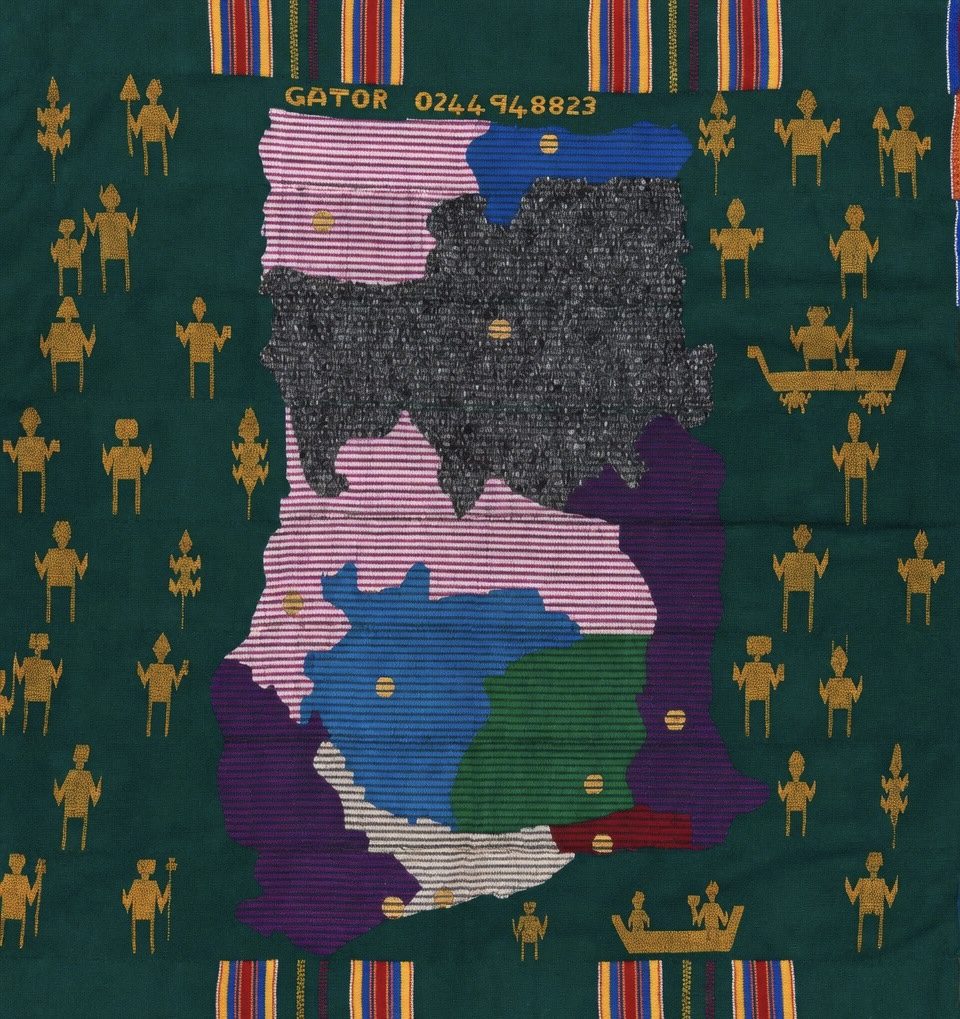
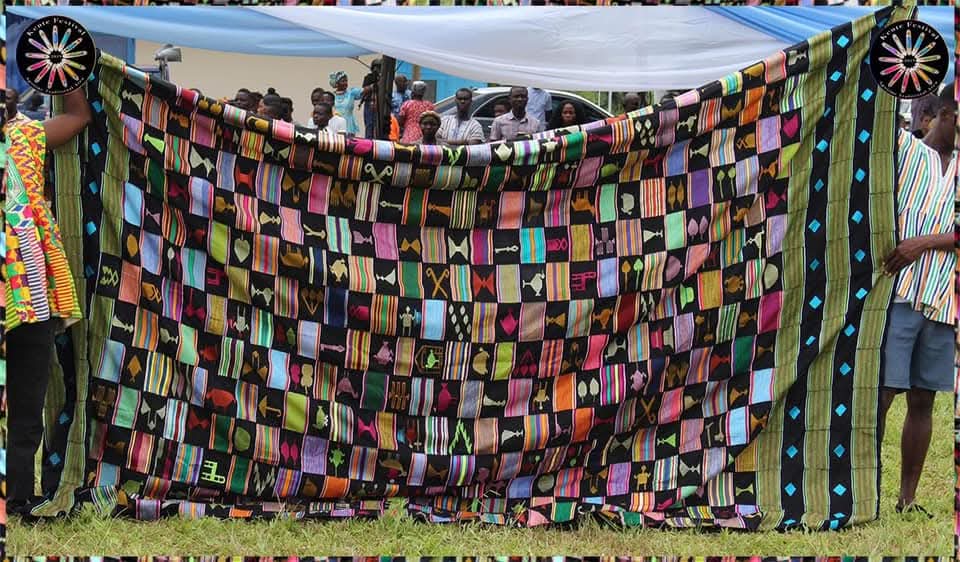
Primary Composition: A singular figural cloth woven in the outline of the Republic of Ghana.
Pattern Meaning & Etymology: Unlike traditional named patterns drawn from proverb, lineage, or court ceremony, Fourth Republic of Ghana is a contemporary commemorative composition. Its title refers to the constitutional era inaugurated on 7 January 1993, which restored civilian democratic government to Ghana after a period of military rule. The cloth is not a repeating pattern in the classical sense; it is a one-of-one cartographic statement, conceived and executed as a unified picture-cloth.
Visual Description & Technical Detail
The piece departs from the rectangular convention of strip-woven Kente. Its silhouette traces the national borders of Ghana, transforming the woven object itself into a map. The surrounding field is a deep, even green — the colour of forest and farmland — and is bordered along its upper and lower edges with vertical bands of red, gold and dark thread, in the manner of Ewe Agotime-Kpetoe selvedges.
Within the green field, scattered across the surrounding territory, are numerous small golden-yellow human figures, each rendered in a slightly different attitude. Several appear to hold staffs or implements of office; others stand in postures of greeting, work, or watchfulness. Read together they form a population — a citizenry — encircling the nation they constitute.
Two small canoe-like vessels, woven in gold, sit upon the green field to the east of the map. They carry standing figures, and may be read as references to inland and coastal waterways — the Volta and the Atlantic seaboard — and to the older histories of trade, fishing and movement that those waters carry.
The map itself is composed in coloured patchwork, each region distinct:
Northern regions: predominantly black and grey, with subtle textural accents.
Upper belt: pale pink and lavender stripes.
Central and western Ghana: bold blue, suggesting the great lake and the rivers.
South-western corner: vivid green, the forest belt.
South-eastern and coastal areas: purple and red accents marking the Volta basin and the seaboard.
Small circular gold motifs are woven through the map sections, lending highlights and a quiet symbolic value — reading variously as towns, light, or wealth held in common.
Across the upper edge of the map, in woven yellow capital letters, runs a single inscription:
GATOR 0244 948823
The inscription is the weaver’s own name and Ghanaian telephone number, woven directly into the cloth. It is an extraordinarily rare gesture in the Kente tradition, where the maker’s hand has historically been recognised through pattern, technique and lineage rather than literal signature. Here, the artisan claims the work as unmistakeably his — and offers, with disarming directness, a means of being reached.
Visual Documentation
Fourth Republic of Ghana, woven by Master Weaver Gator Gbogbo of Agotime-Kpetoe, Volta Region, Ghana. The cloth takes the form of the national outline.
Primary Image: Full view of the cloth, showing its cartographic silhouette, regional patchwork, surrounding figures and woven inscription.
Image Analysis Notes: The geometry departs from the conventional strip-and-stitch rectangle of Kente; the work has been finished to the irregular outline of the country, with selvedges turned to follow the borders. This shaping is itself a technical achievement and one of the cloth’s defining features.
Research Notes
Date of weaving: The artisan locates the cloth in the early years of the Fourth Republic. Circa 1997 is recorded as the working date pending further documentation.
Yarns and ground: The cloth is hand-woven on a traditional Ewe horizontal treadle loom. Fibre analysis is in progress; presentation is consistent with cotton ground with rayon and metallic supplementary wefts of the kind in common use among Agotime-Kpetoe weavers in the late 1990s.
Inscription: The woven legend “GATOR 0244 948823” is documented as part of the artwork itself and is treated here as primary evidence of authorship. The Registry records the inscription as a feature of the cloth and does not present it as a present-day point of contact.
Outstanding questions: Original commission or purpose; subsequent owners and exhibition history; whether the work was conceived as a singular piece or as the first of a small commemorative series. The Registry welcomes correspondence from anyone holding documentation that bears on these questions.
Cultural & Historical Significance
Kente, in its older Asante and Ewe forms, has always been a carrier of meaning. Pattern names invoke proverbs, court histories, family compacts and the moral weight of office. Fourth Republic of Ghana stands within that tradition while extending it: the medium has been turned to speak directly of the nation as a whole.
The choice to render the cloth as the outline of Ghana is not incidental. It is a claim that the country itself can be carried, worn, displayed — that its sovereignty and integrity are matters of common possession. The patchwork of regions reads as a quiet statement of pluralism: north and south, forest and savannah, lake and seaboard, each given its own colour and texture, each bound within a single woven body.
The small golden figures encircling the map carry their own argument. They are unnamed and individually unremarkable, but they are many, and they are within the cloth’s territory rather than outside it. They are the citizens whom the Republic exists to serve.
The inclusion of the weaver’s own name and number, woven in the same yellow as the figures and the boats, is the cloth’s most contemporary gesture. It refuses anonymity. It places the artisan within the work as fully as any of the figures around the border — an act of authorship that is also an act of citizenship.
Connections to the Kente Registry
This profile sits within the Registry alongside the working record of its weaver, Master Weaver Gator Gbogbo of Agotime-Kpetoe. Cross-references to related cloths and to the wider Ewe weaving tradition will be added as the corpus grows.
Fourth Republic of Ghana is recorded by the Registry as a singular figural work. It is preserved here as part of the documentary record of contemporary Ewe Kente: an artefact in which traditional technique, national feeling, and personal authorship are held together in a single woven body.
Credits & Acknowledgements
The Weaver
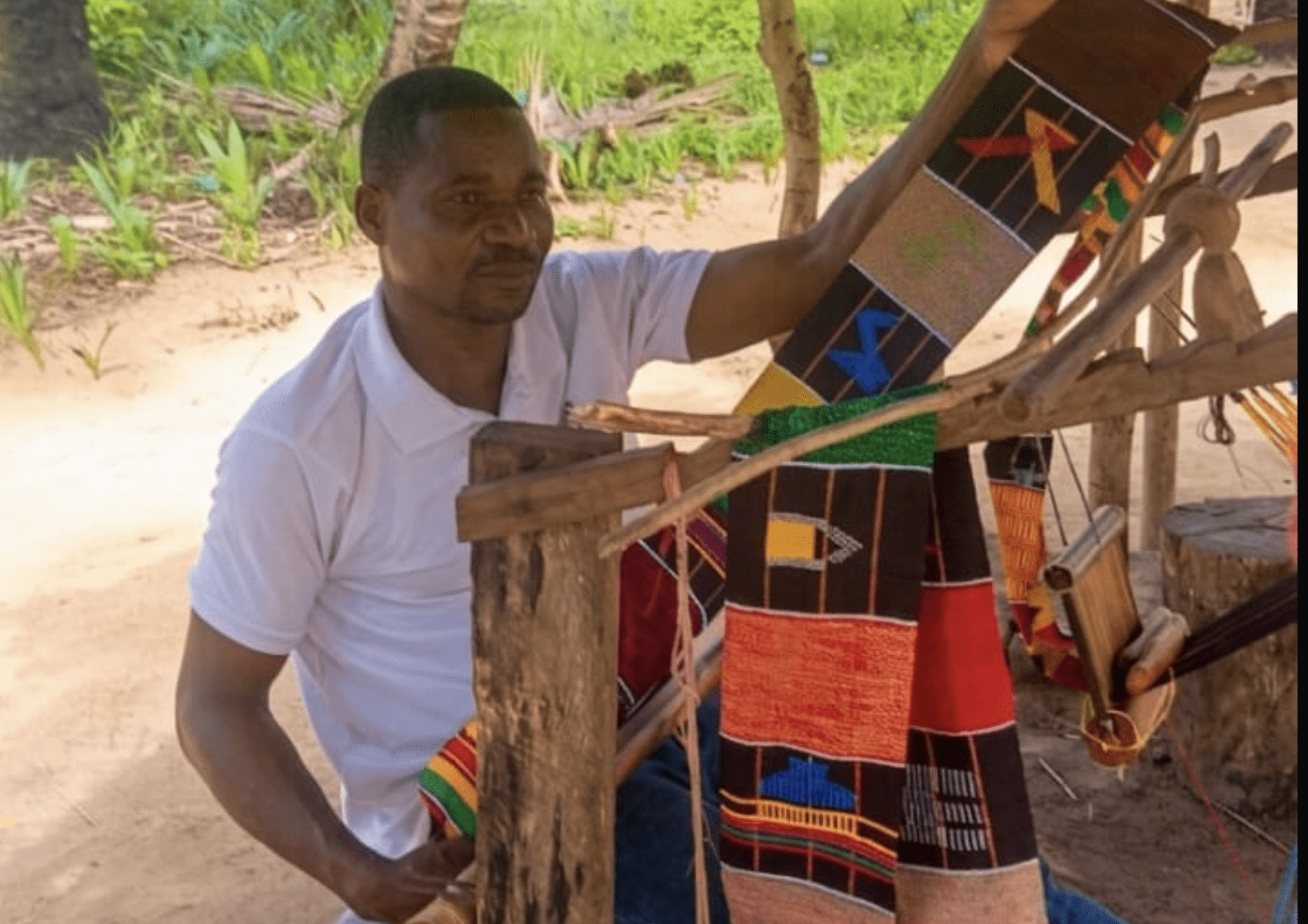
Master Weaver Gator Gbogbo at his loom in Agotime-Kpetoe, Volta Region.
Master Weaver Gator Gbogbo works in the Ewe weaving tradition of Agotime-Kpetoe in Ghana’s Volta Region, an area long recognised for figural and symbolic Kente. Fourth Republic of Ghana is among the most ambitious works in his recorded output: a singular, sculptural cloth that joins technical mastery with an unusually direct civic and personal statement.
Documentation & Photography
Photography and documentation: Kente Registry. Cloth and weaver photographs are held in the Registry’s archive.
Citation
Fourth Republic of Ghana, Master Weaver Gator Gbogbo, Agotime-Kpetoe, circa 1997. Kente Registry, KR-D-2026-15046.
Born 1988; weaving practice since 1992; independent since 2007
Lineage
Soedzedey weaving lineage. Apprenticed to uncles Gabriel Kwashie Abusah (c.1992–2004) and Olympio Abusah (2004–2007). Supplemented with university-level textile education.
Provenance
Verified · GI 2025
Justice Abusah is a master weaver from Agbozume, a historic weaving centre in Ghana’s Volta Region, and an inheritor of the Soedzedey weaving lineage. Born in 1988, he combines deep indigenous apprenticeship with formal textile education, a rare pathway that gives him an unusually reflective perspective on his own tradition.
Lineage and Early Life
Justice Abusah was born in 1988 into the Soedzedey weaving family of Agbozume. The Soedzedey lineage represents generations of accumulated knowledge in weaving, drawing, and textile craft, traditions transmitted orally and through embodied practice within the family. From his earliest years, Justice was immersed in this environment.
His formal weaving practice began in 1992, at approximately four years old, when he was introduced to the loom as part of the natural trajectory for a young male in his household. At the time, weaving was the economic sustenance of the family, and every male child of age entered the apprenticeship without question.
His primary teacher was his uncle, Gabriel Kwashie Abusah, under whose guidance he trained until around 2004. From 2004 to 2007, during his secondary schooling, Justice lived and worked with another uncle, Olympio Abusah, extending his practical knowledge and consolidating his technical foundation. Upon completing secondary school in 2007, he emerged as a fully independent weaver, equipped not only with the inherited craft but also with the educational scaffolding to reflect upon it.
Training and Formal Education
What distinguishes Justice Abusah’s practice is the convergence of indigenous apprenticeship and institutional learning. Following his secondary education, he pursued formal textile studies at university level, a rare pathway that married his embodied knowledge with academic frameworks for understanding colour theory, structural design, and textile history. This dual grounding gives him an unusually reflective perspective on his own tradition: he can articulate the philosophical principles underlying the work of his predecessors while honouring the non-verbal transmission through which he acquired them.
Artistic Mastery and Signature Designs
Justice began his weaving journey with plain cloths (apevor), the foundational form through which every weaver learns the structural grammar of the loom: tension, colour harmony, and thread management. As his skill deepened, he transitioned into more complex forms, incorporating images into woven fabrics during the weaving process itself, a progression that demanded not only technical mastery but also the ability to visualise complex compositions and execute them through loom logic. His practice then extended into float weaves, cloths in which supplementary threads are manipulated to create dimensional effects, raised surfaces, and intricate textural contrasts.
His signature design repertoire now encompasses four distinct forms:
Apevor (Plain): foundational cloths distinguished by colour harmony and thread precision.
Novi: cloths incorporating geometric patterns and structured designs.
Float Weaves: advanced cloths using supplementary threads to create dimensional, textural effects.
Adanuvor (Pictorial, Figurative): complex woven imagery, figurative motifs, symbolic compositions, and narrative scenes rendered entirely through the weave structure.
Pictorial Weaving and Visual Thinking
Justice inherited from his father a natural aptitude for drawing, a skill that, in the Kente tradition, translates directly into the capacity to conceive and execute complex pictorial motifs woven directly into the cloth structure. His progression from plain cloths to pictorial and float weaves was not arbitrary but reflective of deepening conceptual ambition. After a period away from drawing practice, he returned to this discipline and retained his skill with remarkable fluency. His adanuvor cloths represent some of the most technically demanding work in the Kente repertoire: images rendered entirely through the logic of the loom, without recourse to embroidery or other supplementary techniques.
Critical Knowledge and Authentication
Justice Abusah can distinguish between pictorial cloths (in which the image is integral to the weave), geometric cloths (where pattern emerges from colour and thread arrangement), printed imitations (which mimic Kente aesthetics without the labour of weaving), and embroidery-enhanced cloths (where images are added after weaving). This discernment is invaluable for preservation and authentication work. He advocates strongly for documenting and preserving the integrity of authentic woven traditions, resisting the market pressures that incentivise faster or cheaper methods.
Regional Knowledge
Justice possesses deep knowledge of Volta Region weaving practices and their regional variations, the distinct characteristics that distinguish Agbozume cloth from that of Kpetoe, Tafi Atome, and Ashanti centres. This knowledge encompasses not only technique but aesthetic philosophy: the reasoning behind colour choices, pattern sequencing, and the cultural meanings embedded in specific cloths. He understands the historical trajectories of these traditions and their contemporary evolution.
Philosophy and Teaching
Justice Abusah views weaving not as a skill to be acquired but as a cultural inheritance and a practice of endurance. He speaks of weaving as teaching discipline, commitment, and resilience, virtues embedded in the patient, repetitive work at the loom. For him, the practice is inseparable from culture: weaving is how the Soedzedey family, and the Volta Region more broadly, understand and transmit knowledge across generations.
This philosophy extends to his approach to mentorship. He has guided his younger brother into the practice and trained a young man from the community who approached him without prior weaving experience. His influence extends informally to other younger weavers in his circle, transmitted through conversation, observation, and collaborative work. He does not position himself as a charismatic teacher but as a practitioner who shares knowledge with those who come seeking it.
Vision for Documentation
Justice Abusah is an advocate for systematic documentation of weaving traditions across Ghana and beyond. He recognises that the oral-historical knowledge embedded in weaving families, the reasoning behind design choices, the stories attached to specific cloths, the technical innovations developed over generations, is at risk of being lost as economic and social pressures reshape the practice. He supports the creation of a global oral-history archive for Kente, or Kete, as the cloth is known in the Volta Region tradition.
He sees projects like the Kente Registry as inherently multi-generational undertakings, requiring patience and sustained commitment. Documentation is not about freezing tradition, but about giving it the archive it deserves.
Registry Summary
Born and trained in Agbozume, Volta Region. Apprenticed to his uncle Gabriel Kwashie Abusah from age four, with further training under his uncle Olympio Abusah during secondary school, he completed formal textile education at university while maintaining active weaving practice. He is recognised for exceptional skill in pictorial weaving, the creation of complex woven imagery (adanuvor), and for his mastery of plain cloths (apevor), float weaves, and geometric designs (novi). Justice combines deep indigenous knowledge with critical perspective, and he advocates for systematic documentation of Kente weaving histories, techniques, and cultural meanings across Ghana and the African diaspora.
The first thing that strikes you about Master Weaver Gator Gbogbo is his quiet eloquence. Soft-spoken yet precise, he carries the calm authority of someone who has spent a lifetime coaxing stories from silk and cotton, and who has never once doubted the value of what he does.
From Agotime-Kpetoe to the Loom
Master Weaver Gator Gbogbo from Agotime-Kpetoe, Volta Region.
Born in 1964 in Agotime-Kpetoe, in Ghana’s Volta Region, Gbogbo comes from the spiritual heartland of Ewe Kente, known locally as Agbamevor or Kete. He was an only child, orphaned before his fifth birthday, and raised by his grandfather. It was that same grandfather who, when the boy was just eleven, sent him to apprentice with a weaver called Daniel Kofi Aklasu.
“I was obsessed with cars and dreamed of becoming a driver,” Gbogbo recalls with a chuckle. “I thought Mr Aklasu was going to teach me how to drive a real car. Instead, he put me in front of a centuries-old wooden loom and said, this is what you’ll be driving.” The disappointment passed quickly. The work did not. Half a century later, he is still seated at the loom, and the loom is still teaching him.
A Rare and Celebrated Gift
Master Weaver Gator Gbogbo is widely respected in Agotime-Kpetoe and beyond as a figural weaver — a rare designation in a tradition celebrated above all for its geometric patterns and proverb-bearing motifs. Where most weavers tell their stories through the disciplined repetition of named patterns, Gbogbo tells his by drawing recognisable images directly into the cloth: figures, vessels, letters, the outline of a country.
Despite never attending formal school, he is remarkably multilingual. He speaks Ewe, English, Akan, Krobo and French — the last acquired during several years spent practising his craft across the border in Togo. He returned home to Agotime-Kpetoe, where the rhythmic clack of looms still fills the air like a familiar pulse.
A Map of Ghana, Woven in Thread
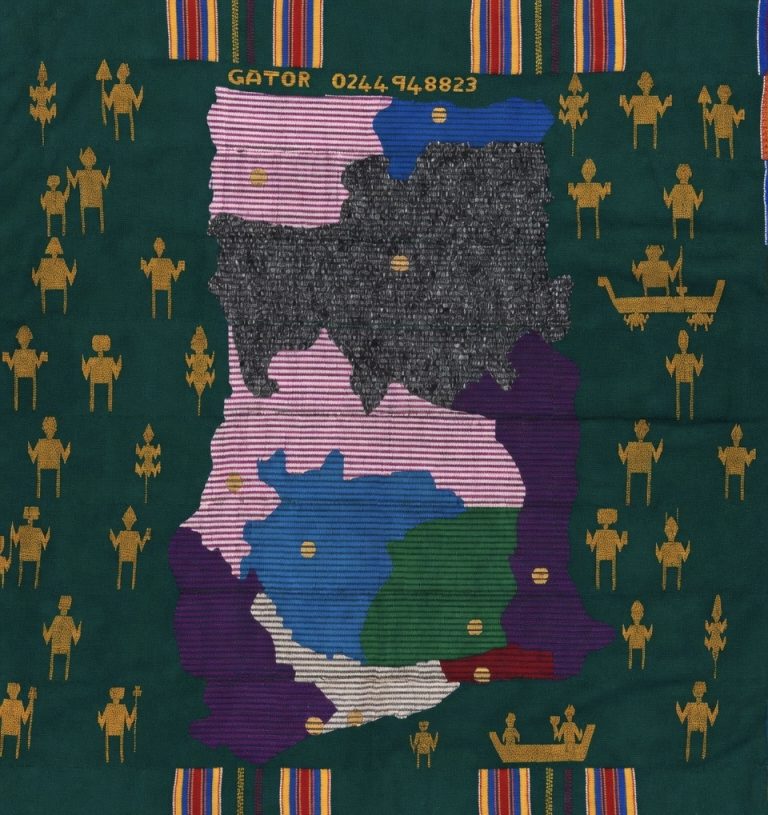
Ghana Map Kente woven by Master Weaver Gator Gbogbo of Agotime-Kpetoe. He calls it “Fourth Republic of Ghana”.
Among his most iconic creations is a vibrant Kente cloth shaped as the outline of Ghana itself, complete with its regions, its waterways and its people. Woven in the distinctive Ewe style of narrow strips sewn together, the piece is a remarkable work of geographic and cultural storytelling. The forested southwest is rendered in green; the great central lake in blue; the northern savannah in black and grey; the upper belt in pale pink and lavender; and the south-eastern coast in purple and red. Around the map, scattered across a deep green field, small golden figures stand watch — the citizens of the Republic encircling the country they constitute.
Yet perhaps the cloth’s most arresting detail is the inscription woven boldly across its upper edge: his own name and mobile telephone number, rendered in yellow capitals. “It’s my signature,” he says simply. “I wove it in 1997, and I call it Fourth Republic of Ghana. I wanted everyone to know I made it.”
The gesture is more than an act of self-promotion. Having seen too many anonymous Kente cloths circulate widely — particularly through books and exhibitions — Gbogbo resolved that the world should know exactly whose hands had brought the design to life. It is a declaration of authorship as bold as it is elegant: not ink on paper, not a label on a tag, but thread, colour, and permanence.
The woven inscription on Fourth Republic of Ghana — the bold, unflinching GATOR 0244 948823 running across the top of the map — is one of the most singular gestures in contemporary Kente. In a tradition where the maker’s hand has historically been recognised through pattern, lineage and technique rather than literal signature, Gbogbo claims the work as unmistakeably his.
It is also, characteristically, a gesture of openness. The inscription is rendered in the same yellow as the encircling figures and the small canoes on the eastern field; the weaver places himself within the cloth’s population, not above it. Authorship and citizenship are woven, here, as one and the same act.
Passing the Torch
Now a father of four, with his youngest child aged twelve, Gbogbo is quietly passing the torch. “I’m already teaching him the basics after school,” he shares. The boy is roughly the same age Gbogbo himself was when he first sat at the loom — a detail that carries the weight of continuity in a tradition that lives, generation after generation, in the steady transfer of skill from elder to apprentice.
Gbogbo does not merely weave cloth; he weaves identity, geography, and legacy. By threading his own name into a map of the nation, this master artisan has stitched himself into Ghanaian cultural history in the most authentic way possible: one colourful, enduring thread at a time.
In the Registry
Master Weaver Gator Gbogbo is recorded by the Kente Registry as a verified figural weaver in the Ewe Agotime-Kpetoe tradition. His documented works in the Registry include:
Documentation of additional works is in progress. The Registry welcomes correspondence from owners, collectors and institutions holding Kente attributable to Master Weaver Gator Gbogbo.
Trained seven years under Mr. Animli of Agotime-Kpetoe (deceased) and Koku Ahuga of Agbozume. Independent practice since 1981.
Provenance
Verified · GI 2025
Christian Kofi Hodor
Master Weaver · Agotime Kpetoe · Volta Region, Ghana
Born
1961, Agotime Kpetoe
Tradition
Agotime Kpetoe Kente Weaving
Training
Seven years under Mr. Animli, Agotime-Kpetoe (dec.)
Koku Ahuga (Agbozume)
Independent Since
1981
Specialisation
Figural and symbolic weaving (“Writing”)
Biography
Master Weaver Christian Kofi Hodor from Agotime-Kpetoe
In the town of Agotime Kpetoe, in Ghana’s Volta Region, the craft of weaving carries a weight that outsiders often fail to grasp. Weaving here goes beyond ornament or commodity. Instead, it represents the visible form of a people’s understanding of themselves, their history rendered in thread, their pride made wearable.
Christian Kofi Hodor, born in September 1961, belongs to this tradition not as someone who simply chose it, but as one to whom it fell by birthright. For seven years, he trained under his late master, Mr. Animli, moving through the full vocabulary of Agotime weaving. During that time, he learned its structures, its naming conventions, and its unwritten protocols of pattern and colour. Above all, this extended apprenticeship gave him more than preparation for independent work. It shaped his mind, slowly building the ability to hold forms in the loom and see them through to completion.
In 1981, he began weaving independently. Over the four decades since, he has built a body of work that bears the unmistakable signature of an original hand. Every design originates from his own imagination, conceived in thought, executed in the loom, and given a name that carries meaning within the community. Notably, chiefs at Kente festivals have worn his cloths, among them Nene Akoto Sah. In a tradition where cloth and chiefly identity remain inseparable, such recognition goes beyond ceremony. Rather, it signals true acknowledgement.
Recognition & Awards
The Kente (kete) cloth the weaver called “Xexiamɛ Dɔatsɔ” in Ewe. In English, the name means, “The World is Beautiful.”
One design, in particular, has transcended the annual cycle of festival display and entered the permanent record of Kpetoe’s weaving culture: Xexiamɛ Dɔatsɔ. In English, the name means, “The World is Beautiful.” This cloth won prizes at the Kente Festival in consecutive years, 2014 and 2015. Such recognition speaks to a design of unusual coherence and depth.
Moreover, the festivals at Agotime Kpetoe are not peripheral events that celebrate craftsmanship in the abstract. On the contrary, they serve as the primary arena where the community’s weavers face assessment by one another, by their chiefs, and by the wider public. As a result, an award at these festivals carries real weight. It represents a verdict, not just an honour.
Craft & Specialisation
Within the weaving community, fellow weavers identify Mr. Hodor as one of its finest “writers.” In Kente culture, this term carries considerable precision. Specifically, a writer possesses the skill to render words, symbols, maps, animals, and human figures directly into the cloth’s structure. This demanding work goes beyond the abstract. In essence, it requires representational skill of the highest kind.
While most weavers work with geometric patterns that follow the weave structure’s inherent logic, a writer must hold representational forms in both mind and loom at once. For example, a line drawn by hand on paper becomes a series of choices about which thread passes over and which passes under. Similarly, a bird’s wing, a map’s border, or a human profile must each take shape from within the fabric, strip by narrow strip. Only when the weaver assembles the full cloth do these forms become visible. Few weavers practise this demanding technique.
Mr. Hodor’s range of woven forms is considerable. His work includes inscriptions woven directly into the cloth, cartographic outlines, figurative animals, human silhouettes, and symbolic devices. Furthermore, the meanings of these devices shift between the literal and the ceremonial. Each form begins as an idea, then becomes a series of structural calculations, and finally emerges as cloth.
On the Craft and Its Future
Mr. Hodor speaks of Kente not only as a livelihood but also as a carrier of collective identity. Through this art form, the history and pride of the Agotime people become visible and wearable, passing from hand to hand through generations. Importantly, he avoids speaking of tradition in the language of nostalgia. Instead, he describes it as a living thing that requires active support to stay alive.
At the same time, he remains frank about the pressures facing weavers today. Reliable buyers are hard to find. Both domestic and international markets remain thin. Consequently, a craft requiring years of formation risks losing its next generation to work that pays more immediately and demands less patience. Over the years, he has watched these pressures narrow the circle of active weavers, and he understands what stands at stake.
Despite these challenges, he maintains a clear-eyed perspective rather than a pessimistic one. In his view, the cloth needs better promotion, and its cultural significance deserves wider communication beyond Ghana’s boundaries. Likewise, he argues that weavers deserve better support, not as museum pieces, but as living practitioners of a living craft. He also encourages young people to learn the art, not as a gesture toward the past, but because he recognises a crucial truth: once a living tradition breaks, the knowledge it carries does not easily reconstitute itself. Some losses, after all, are permanent.
In the Registry
The Kente Registry documents Christian Kofi Hodor’s work as part of our commitment to preserving the living record of Kente weaving. As a result, his designs, training lineage, technical specialisations, and role within the Agotime Kpetoe weaving community now form part of a permanent, authenticated record. Researchers, future weavers, and anyone who wishes to understand this tradition’s depth and sophistication can access it freely.
The Registry exists precisely for this purpose: to ensure that masters like Mr. Hodor see their knowledge recorded, honoured, and made available to those who come after.
KenteRegistry.org – RECORDING THE WEAVERS, DESIGNS, AND CLOTHS OF KENTE FOR ALL TIME
Manage Consent
To provide the best experiences, we use technologies like cookies to store and/or access device information. Consenting to these technologies will allow us to process data such as browsing behavior or unique IDs on this site. Not consenting or withdrawing consent, may adversely affect certain features and functions.
Functional
Always active
The technical storage or access is strictly necessary for the legitimate purpose of enabling the use of a specific service explicitly requested by the subscriber or user, or for the sole purpose of carrying out the transmission of a communication over an electronic communications network.
Preferences
The technical storage or access is necessary for the legitimate purpose of storing preferences that are not requested by the subscriber or user.
Statistics
The technical storage or access that is used exclusively for statistical purposes.The technical storage or access that is used exclusively for anonymous statistical purposes. Without a subpoena, voluntary compliance on the part of your Internet Service Provider, or additional records from a third party, information stored or retrieved for this purpose alone cannot usually be used to identify you.
Marketing
The technical storage or access is required to create user profiles to send advertising, or to track the user on a website or across several websites for similar marketing purposes.