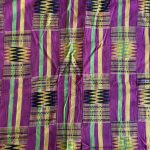
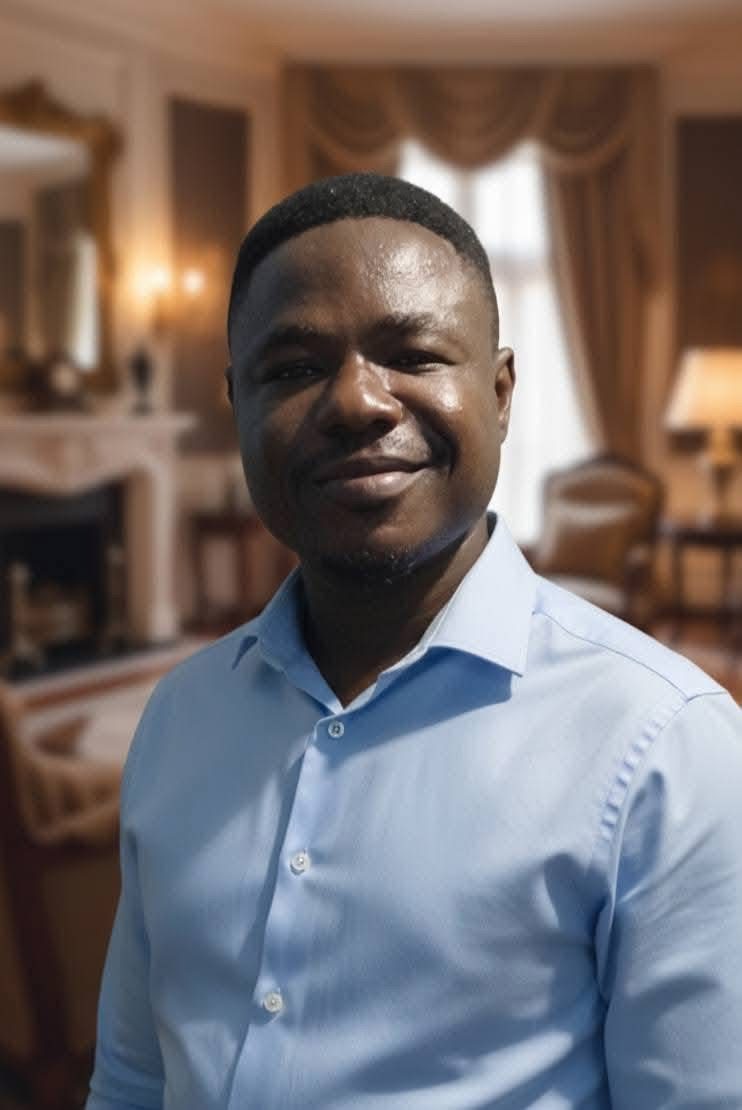
- Name
- Justice Abusah
- Registry No.
- KR-W-2026-15045
- Community
- Agbozume
- Workshop
- Agbozume, Volta Region, Ghana
- Years Active
- Born 1988; weaving practice since 1992; independent since 2007
- Lineage
- Soedzedey weaving lineage. Apprenticed to uncles Gabriel Kwashie Abusah (c.1992–2004) and Olympio Abusah (2004–2007). Supplemented with university-level textile education.
- Provenance
- Verified · GI 2025
Justice Abusah is a master weaver from Agbozume, a historic weaving centre in Ghana’s Volta Region, and an inheritor of the Soedzedey weaving lineage. Born in 1988, he combines deep indigenous apprenticeship with formal textile education, a rare pathway that gives him an unusually reflective perspective on his own tradition.
Lineage and Early Life
Justice Abusah was born in 1988 into the Soedzedey weaving family of Agbozume. The Soedzedey lineage represents generations of accumulated knowledge in weaving, drawing, and textile craft, traditions transmitted orally and through embodied practice within the family. From his earliest years, Justice was immersed in this environment.
His formal weaving practice began in 1992, at approximately four years old, when he was introduced to the loom as part of the natural trajectory for a young male in his household. At the time, weaving was the economic sustenance of the family, and every male child of age entered the apprenticeship without question.
His primary teacher was his uncle, Gabriel Kwashie Abusah, under whose guidance he trained until around 2004. From 2004 to 2007, during his secondary schooling, Justice lived and worked with another uncle, Olympio Abusah, extending his practical knowledge and consolidating his technical foundation. Upon completing secondary school in 2007, he emerged as a fully independent weaver, equipped not only with the inherited craft but also with the educational scaffolding to reflect upon it.
Training and Formal Education
What distinguishes Justice Abusah’s practice is the convergence of indigenous apprenticeship and institutional learning. Following his secondary education, he pursued formal textile studies at university level, a rare pathway that married his embodied knowledge with academic frameworks for understanding colour theory, structural design, and textile history. This dual grounding gives him an unusually reflective perspective on his own tradition: he can articulate the philosophical principles underlying the work of his predecessors while honouring the non-verbal transmission through which he acquired them.
Artistic Mastery and Signature Designs
Justice began his weaving journey with plain cloths (apevor), the foundational form through which every weaver learns the structural grammar of the loom: tension, colour harmony, and thread management. As his skill deepened, he transitioned into more complex forms, incorporating images into woven fabrics during the weaving process itself, a progression that demanded not only technical mastery but also the ability to visualise complex compositions and execute them through loom logic. His practice then extended into float weaves, cloths in which supplementary threads are manipulated to create dimensional effects, raised surfaces, and intricate textural contrasts.
His signature design repertoire now encompasses four distinct forms:
- Apevor (Plain): foundational cloths distinguished by colour harmony and thread precision.
- Novi: cloths incorporating geometric patterns and structured designs.
- Float Weaves: advanced cloths using supplementary threads to create dimensional, textural effects.
- Adanuvor (Pictorial, Figurative): complex woven imagery, figurative motifs, symbolic compositions, and narrative scenes rendered entirely through the weave structure.
Pictorial Weaving and Visual Thinking
Justice inherited from his father a natural aptitude for drawing, a skill that, in the Kente tradition, translates directly into the capacity to conceive and execute complex pictorial motifs woven directly into the cloth structure. His progression from plain cloths to pictorial and float weaves was not arbitrary but reflective of deepening conceptual ambition. After a period away from drawing practice, he returned to this discipline and retained his skill with remarkable fluency. His adanuvor cloths represent some of the most technically demanding work in the Kente repertoire: images rendered entirely through the logic of the loom, without recourse to embroidery or other supplementary techniques.
Critical Knowledge and Authentication
Justice Abusah can distinguish between pictorial cloths (in which the image is integral to the weave), geometric cloths (where pattern emerges from colour and thread arrangement), printed imitations (which mimic Kente aesthetics without the labour of weaving), and embroidery-enhanced cloths (where images are added after weaving). This discernment is invaluable for preservation and authentication work. He advocates strongly for documenting and preserving the integrity of authentic woven traditions, resisting the market pressures that incentivise faster or cheaper methods.
Regional Knowledge
Justice possesses deep knowledge of Volta Region weaving practices and their regional variations, the distinct characteristics that distinguish Agbozume cloth from that of Kpetoe, Tafi Atome, and Ashanti centres. This knowledge encompasses not only technique but aesthetic philosophy: the reasoning behind colour choices, pattern sequencing, and the cultural meanings embedded in specific cloths. He understands the historical trajectories of these traditions and their contemporary evolution.
Philosophy and Teaching
Justice Abusah views weaving not as a skill to be acquired but as a cultural inheritance and a practice of endurance. He speaks of weaving as teaching discipline, commitment, and resilience, virtues embedded in the patient, repetitive work at the loom. For him, the practice is inseparable from culture: weaving is how the Soedzedey family, and the Volta Region more broadly, understand and transmit knowledge across generations.
This philosophy extends to his approach to mentorship. He has guided his younger brother into the practice and trained a young man from the community who approached him without prior weaving experience. His influence extends informally to other younger weavers in his circle, transmitted through conversation, observation, and collaborative work. He does not position himself as a charismatic teacher but as a practitioner who shares knowledge with those who come seeking it.
Vision for Documentation
Justice Abusah is an advocate for systematic documentation of weaving traditions across Ghana and beyond. He recognises that the oral-historical knowledge embedded in weaving families, the reasoning behind design choices, the stories attached to specific cloths, the technical innovations developed over generations, is at risk of being lost as economic and social pressures reshape the practice. He supports the creation of a global oral-history archive for Kente, or Kete, as the cloth is known in the Volta Region tradition.
He sees projects like the Kente Registry as inherently multi-generational undertakings, requiring patience and sustained commitment. Documentation is not about freezing tradition, but about giving it the archive it deserves.
Registry Summary
Born and trained in Agbozume, Volta Region. Apprenticed to his uncle Gabriel Kwashie Abusah from age four, with further training under his uncle Olympio Abusah during secondary school, he completed formal textile education at university while maintaining active weaving practice. He is recognised for exceptional skill in pictorial weaving, the creation of complex woven imagery (adanuvor), and for his mastery of plain cloths (apevor), float weaves, and geometric designs (novi). Justice combines deep indigenous knowledge with critical perspective, and he advocates for systematic documentation of Kente weaving histories, techniques, and cultural meanings across Ghana and the African diaspora.