
- Name
- Nana Akwessi Afrane
- Registry No.
- KR-W-2026-15044
- Community
- Bonwire
- Workshop
- Asante region, Ghana (precise location unknown)
- Years Active
- Active circa 1980
- Lineage
- Chief weaver of Asante, a stool position conferred by the Asantehene. Full apprenticeship and training record unknown.
- Provenance
- Research in Progress
Somewhere in Ghana, in the early months of 1981, a man carried a selection of freshly woven kente cloth into a transaction that would send it, quietly and permanently, to the other side of the world. His name was Nana Akwessi Afrane. His title, recorded in the British Museum’s purchase book at the time of acquisition, was chief weaver of Asante.
That is very nearly all we know.
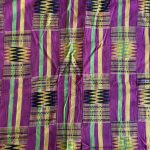
The cloth, at least nine strips across two lots, woven in cotton, in the colours of burgundy, green, black, and yellow, passed into the Africa, Oceania and Americas collection at the British Museum in London, where it was catalogued, numbered, and consigned to storage. It has not been on public display. The museum’s record names the maker only in a footnote, and only by the role he held at the point of sale: vendor. The man behind the title vanishes from the archive.
Yet the title itself speaks. In Asante tradition, the role of chief weaver is not an honorary one. It is a stool position, conferred by the Asantehene and held within the formal hierarchy of the court at Kumasi. The weavers of Bonwire, the royal weaving village from which the Asantehene’s own cloth has been drawn for centuries, are organised under a succession of titled chiefs, among them the Kentehene, the Yokomaahene, and the Awinfohene. To hold any such title in 1980 was to stand within a living lineage stretching back to the court of Osei Tutu I. It was not a casual distinction.
Nana Akwessi Afrane, then, was no ordinary vendor. He was a custodian of one of the most demanding and storied craft traditions in West Africa, producing cloth that the museum buyer noted had been woven “in the last year or two”, work made not for a foreign collector, but as the ordinary output of a master still at the height of his practice. That the cloth found its way to London at all was simply commerce. What it represented was something far older.
The strips he sold measure 204 centimetres in length and 10 centimetres across, the standard geometry of Asante strip-weaving, each one a self-contained unit of pattern and intention, designed to be joined with its companions into a cloth that would speak, in colour and design, to those who knew how to read it. Burgundy carries the weight of maturity and elevated status. Green speaks of growth and renewal. Black signals union with the ancestors. Yellow, the colour closest to gold, invokes wealth and royalty. These were not decorative choices. They were a vocabulary.
Who chose that vocabulary? What patterns did those strips carry? What name did the cloth bear, for every Asante kente bears a name, drawn from proverb, history, or the weaver’s own philosophical inheritance? These questions remain open. The British Museum’s record does not say.
A Name Worth Following
The name Afrane carries its own resonance in Asante history. It is associated most prominently with the royal lineage of Edweso, the town of Nana Akwasi Afrane Okpese, a nineteenth-century Edwesohene whose name still figures in Ashanti oral tradition. Whether Nana Akwessi Afrane the weaver belonged to that lineage, or bore the name through other ancestry, is one of the questions this profile cannot yet answer. It is, however, a question worth asking.
An Open Record
Ashanti chieftaincy keeps succession records. The Manhyia Palace archives in Kumasi maintain documentation of traditional title holders. The weaving communities of Bonwire and Adanwomase carry long oral memories. Descendants, apprentices, or contemporaries of a chief weaver active in 1980 are, in all likelihood, still reachable.
This profile is offered not as a closed account, but as an opening. If you know who Nana Akwessi Afrane was, if you are his descendant, his student, or simply someone who holds a piece of his story, Kente Registry wants to hear from you.
His cloth is in London. His name deserves to be here.
Known Details
- Active circa 1980
- Held the title of chief weaver of Asante
- Sold kente cloth to the British Museum in 1981 (accession numbers Af1981,26 and Af1981,27)
- Cotton strip weaver
- Production attributed to Ghana
- Further biographical details unknown
Sources: British Museum Collection Online, accession records Af1981,26.4 and related entries.
Do you have information about Nana Akwessi Afrane? Contact Kente Registry →