- Name
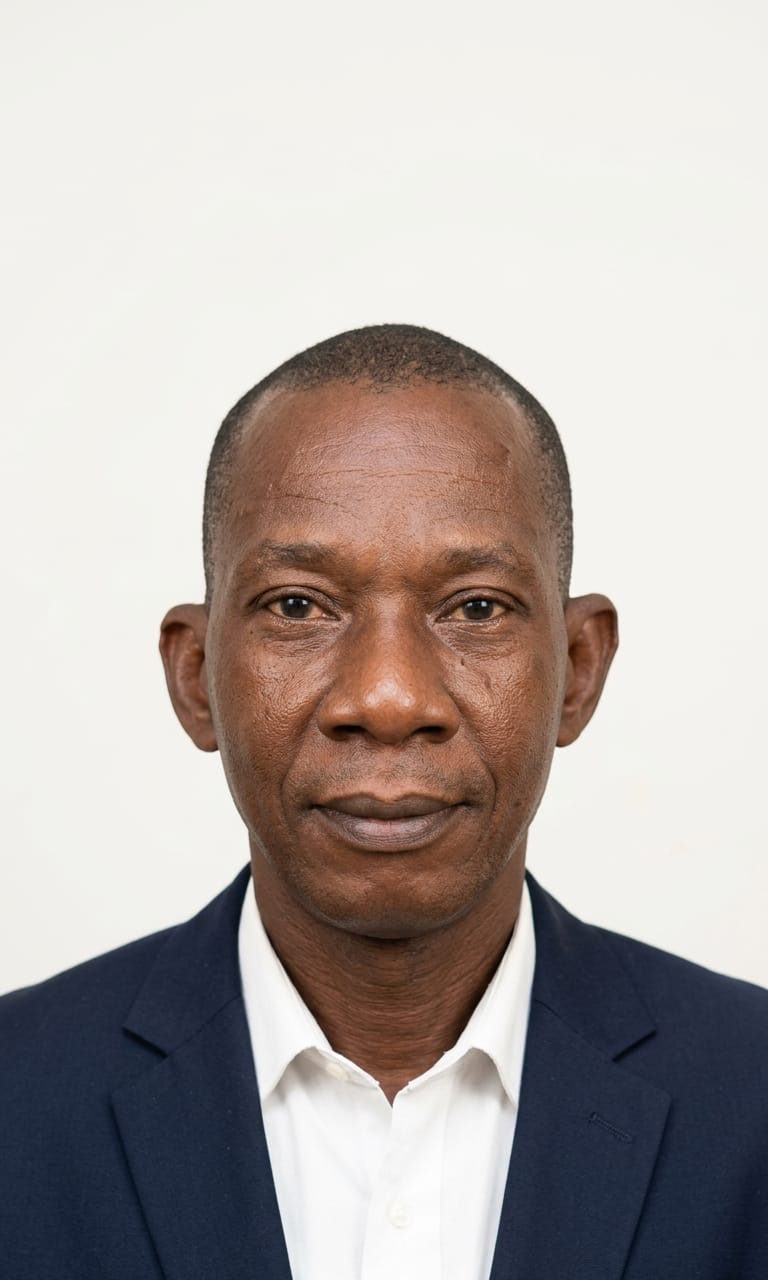
- Christian Kofi Hodor (Aba)
- Registry No.
- KR-W-2026-15042
- Community
- Agbozume · Agotime-Kpetoe
- Workshop
- Agotime Kpetoe, Volta Region, Ghana
- Years Active
- 1981–present
- Lineage
- Trained seven years under Mr. Animli of Agotime-Kpetoe (deceased) and Koku Ahuga of Agbozume. Independent practice since 1981.
- Provenance
- Verified · GI 2025
Christian Kofi Hodor
Master Weaver · Agotime Kpetoe · Volta Region, Ghana
Born 1961, Agotime Kpetoe
Tradition Agotime Kpetoe Kente Weaving
Training Seven years under Mr. Animli, Agotime-Kpetoe (dec.)
Koku Ahuga (Agbozume)
Independent Since 1981
Specialisation Figural and symbolic weaving (“Writing”)
Biography

In the town of Agotime Kpetoe, in Ghana’s Volta Region, the craft of weaving carries a weight that outsiders often fail to grasp. Weaving here goes beyond ornament or commodity. Instead, it represents the visible form of a people’s understanding of themselves, their history rendered in thread, their pride made wearable.
Christian Kofi Hodor, born in September 1961, belongs to this tradition not as someone who simply chose it, but as one to whom it fell by birthright. For seven years, he trained under his late master, Mr. Animli, moving through the full vocabulary of Agotime weaving. During that time, he learned its structures, its naming conventions, and its unwritten protocols of pattern and colour. Above all, this extended apprenticeship gave him more than preparation for independent work. It shaped his mind, slowly building the ability to hold forms in the loom and see them through to completion.
In 1981, he began weaving independently. Over the four decades since, he has built a body of work that bears the unmistakable signature of an original hand. Every design originates from his own imagination, conceived in thought, executed in the loom, and given a name that carries meaning within the community. Notably, chiefs at Kente festivals have worn his cloths, among them Nene Akoto Sah. In a tradition where cloth and chiefly identity remain inseparable, such recognition goes beyond ceremony. Rather, it signals true acknowledgement.
Recognition & Awards
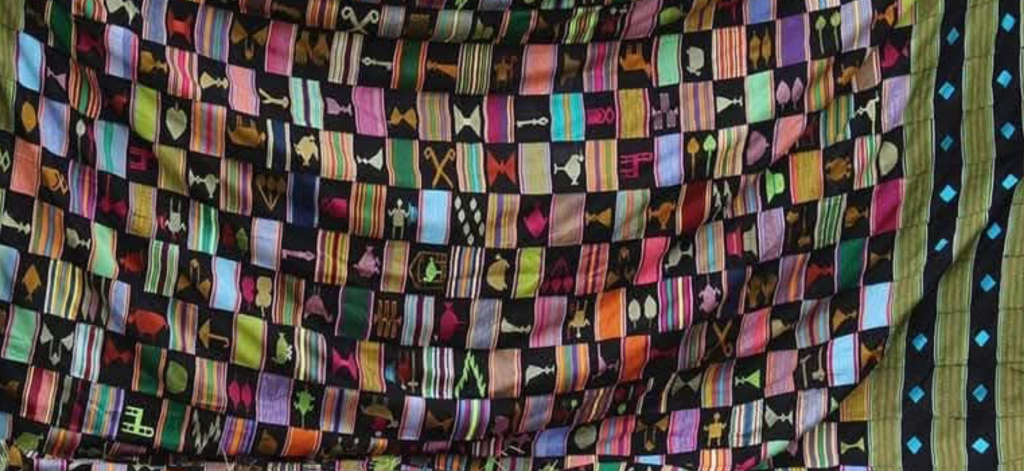
One design, in particular, has transcended the annual cycle of festival display and entered the permanent record of Kpetoe’s weaving culture: Xexiamɛ Dɔatsɔ. In English, the name means, “The World is Beautiful.” This cloth won prizes at the Kente Festival in consecutive years, 2014 and 2015. Such recognition speaks to a design of unusual coherence and depth.
Moreover, the festivals at Agotime Kpetoe are not peripheral events that celebrate craftsmanship in the abstract. On the contrary, they serve as the primary arena where the community’s weavers face assessment by one another, by their chiefs, and by the wider public. As a result, an award at these festivals carries real weight. It represents a verdict, not just an honour.
Craft & Specialisation
Within the weaving community, fellow weavers identify Mr. Hodor as one of its finest “writers.” In Kente culture, this term carries considerable precision. Specifically, a writer possesses the skill to render words, symbols, maps, animals, and human figures directly into the cloth’s structure. This demanding work goes beyond the abstract. In essence, it requires representational skill of the highest kind.
While most weavers work with geometric patterns that follow the weave structure’s inherent logic, a writer must hold representational forms in both mind and loom at once. For example, a line drawn by hand on paper becomes a series of choices about which thread passes over and which passes under. Similarly, a bird’s wing, a map’s border, or a human profile must each take shape from within the fabric, strip by narrow strip. Only when the weaver assembles the full cloth do these forms become visible. Few weavers practise this demanding technique.
Mr. Hodor’s range of woven forms is considerable. His work includes inscriptions woven directly into the cloth, cartographic outlines, figurative animals, human silhouettes, and symbolic devices. Furthermore, the meanings of these devices shift between the literal and the ceremonial. Each form begins as an idea, then becomes a series of structural calculations, and finally emerges as cloth.
On the Craft and Its Future
Mr. Hodor speaks of Kente not only as a livelihood but also as a carrier of collective identity. Through this art form, the history and pride of the Agotime people become visible and wearable, passing from hand to hand through generations. Importantly, he avoids speaking of tradition in the language of nostalgia. Instead, he describes it as a living thing that requires active support to stay alive.
At the same time, he remains frank about the pressures facing weavers today. Reliable buyers are hard to find. Both domestic and international markets remain thin. Consequently, a craft requiring years of formation risks losing its next generation to work that pays more immediately and demands less patience. Over the years, he has watched these pressures narrow the circle of active weavers, and he understands what stands at stake.
Despite these challenges, he maintains a clear-eyed perspective rather than a pessimistic one. In his view, the cloth needs better promotion, and its cultural significance deserves wider communication beyond Ghana’s boundaries. Likewise, he argues that weavers deserve better support, not as museum pieces, but as living practitioners of a living craft. He also encourages young people to learn the art, not as a gesture toward the past, but because he recognises a crucial truth: once a living tradition breaks, the knowledge it carries does not easily reconstitute itself. Some losses, after all, are permanent.
In the Registry
The Kente Registry documents Christian Kofi Hodor’s work as part of our commitment to preserving the living record of Kente weaving. As a result, his designs, training lineage, technical specialisations, and role within the Agotime Kpetoe weaving community now form part of a permanent, authenticated record. Researchers, future weavers, and anyone who wishes to understand this tradition’s depth and sophistication can access it freely.
The Registry exists precisely for this purpose: to ensure that masters like Mr. Hodor see their knowledge recorded, honoured, and made available to those who come after.
KenteRegistry.org – RECORDING THE WEAVERS, DESIGNS, AND CLOTHS OF KENTE FOR ALL TIME
Public Interview
Christian Kofi Hodor on his life and weaving practice
Christian Kofi Hodor reflects on his early life in Agotime-Kpetoe, his training under Mr. Animli, his independent practice since 1981, and the symbolic and figural weaving for which he is known.