Weaving Community: Agotime-Kpetoe

Centre of Ewe Kente weaving – Volta Region.

  • Gator Gbogbo, The Master Weaver Who Maps a Nation in Thread

    Gator Gbogbo, The Master Weaver Who Maps a Nation in Thread

    Master Weaver KR-W-2026-15043
    Name
    Gator Gbogbo
    Registry No.
    KR-W-2026-15043
    Born
    1964, Agotime-Kpetoe, Volta Region, Ghana
    Community
    Agotime-Kpetoe
    Workshop
    Agotime-Kpetoe, Volta Region, Ghana
    Tradition
    Ewe Kente (Agbamevor · Kete)
    Years Active
    circa 1975 – present
    Training
    Apprenticed to Daniel Kofi Aklasu, Agotime-Kpetoe
    Specialisation
    Figural & pictorial weaving
    Languages
    Ewe · English · Akan · Krobo · French
    Provenance
    Verified · GI 2025

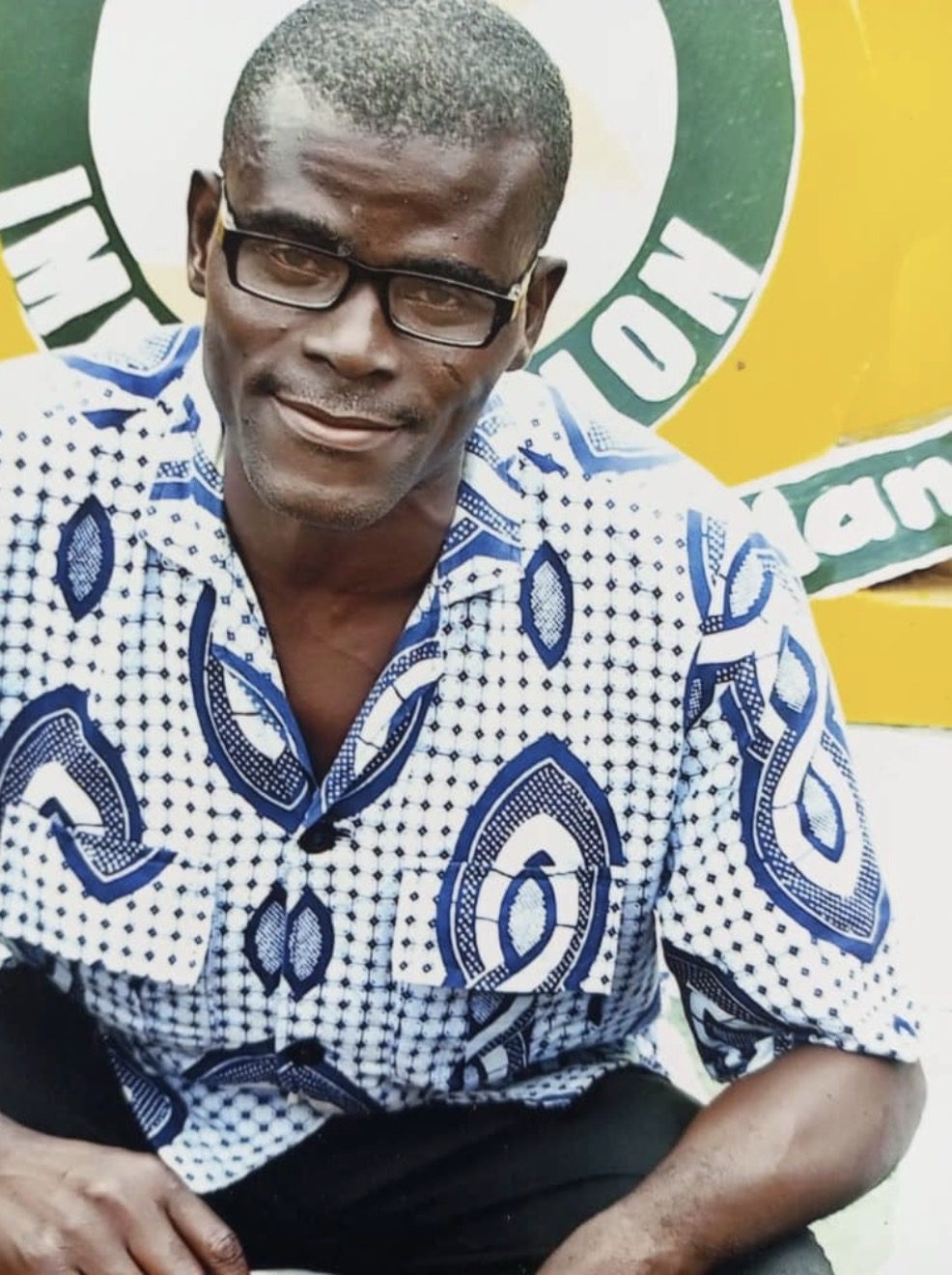
    The first thing that strikes you about Master Weaver Gator Gbogbo is his quiet eloquence. Soft-spoken yet precise, he carries the calm authority of someone who has spent a lifetime coaxing stories from silk and cotton, and who has never once doubted the value of what he does.

    From Agotime-Kpetoe to the Loom

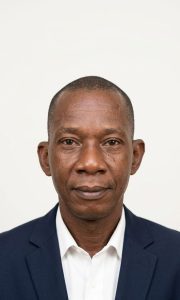
    Master Weaver Gator Gbogbo of Agotime-Kpetoe in the Volta Region.
    Master Weaver Gator Gbogbo from Agotime-Kpetoe, Volta Region.

    Born in 1964 in Agotime-Kpetoe, in Ghana’s Volta Region, Gbogbo comes from the spiritual heartland of Ewe Kente, known locally as Agbamevor or Kete. He was an only child, orphaned before his fifth birthday, and raised by his grandfather. It was that same grandfather who, when the boy was just eleven, sent him to apprentice with a weaver called Daniel Kofi Aklasu.

    “I was obsessed with cars and dreamed of becoming a driver,” Gbogbo recalls with a chuckle. “I thought Mr Aklasu was going to teach me how to drive a real car. Instead, he put me in front of a centuries-old wooden loom and said, this is what you’ll be driving.” The disappointment passed quickly. The work did not. Half a century later, he is still seated at the loom, and the loom is still teaching him.


    A Rare and Celebrated Gift

    Master Weaver Gator Gbogbo is widely respected in Agotime-Kpetoe and beyond as a figural weaver — a rare designation in a tradition celebrated above all for its geometric patterns and proverb-bearing motifs. Where most weavers tell their stories through the disciplined repetition of named patterns, Gbogbo tells his by drawing recognisable images directly into the cloth: figures, vessels, letters, the outline of a country.

    Despite never attending formal school, he is remarkably multilingual. He speaks Ewe, English, Akan, Krobo and French — the last acquired during several years spent practising his craft across the border in Togo. He returned home to Agotime-Kpetoe, where the rhythmic clack of looms still fills the air like a familiar pulse.


    A Map of Ghana, Woven in Thread

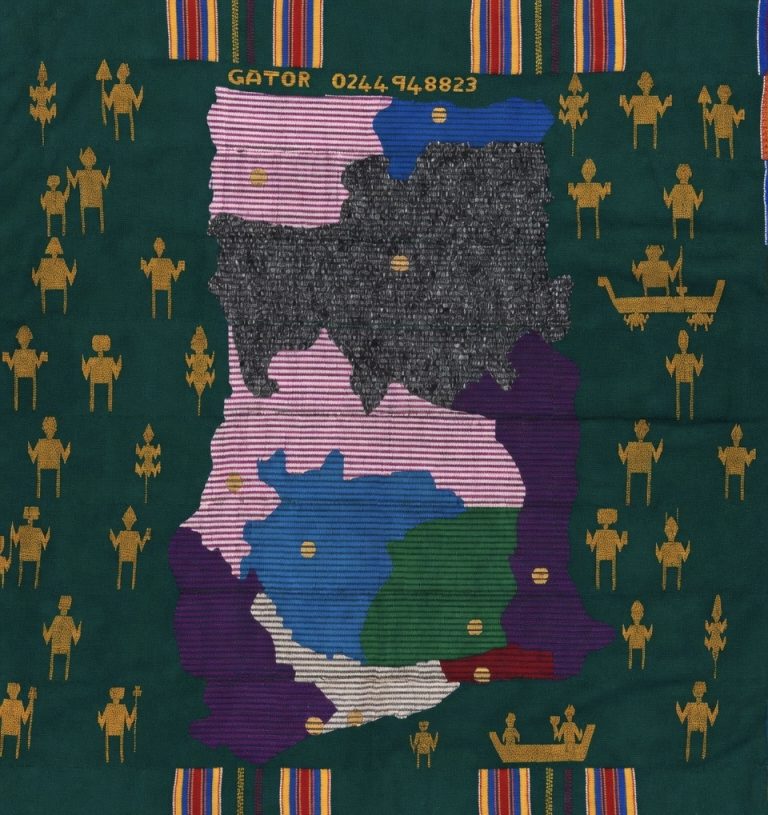
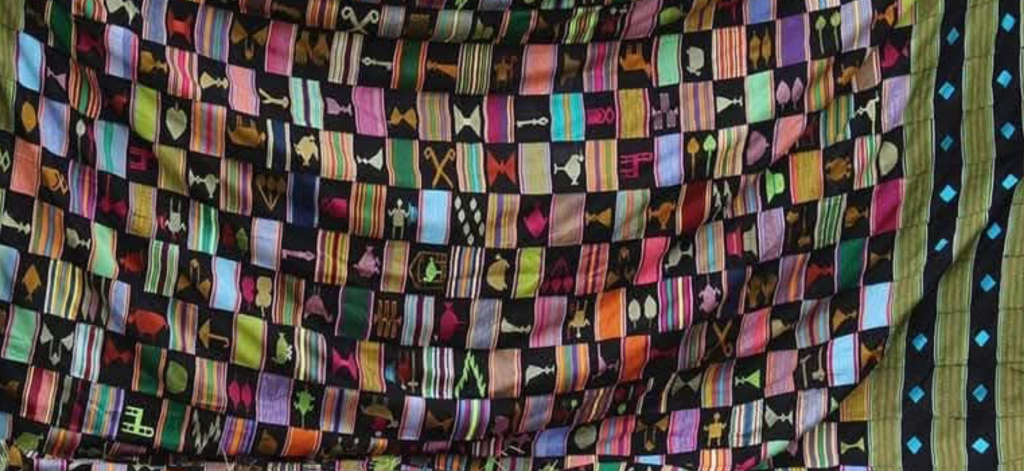
    Ghana Map Kente woven by Master Weaver Gator Gbogbo of Agotime-Kpetoe. He calls it “Fourth Republic of Ghana”
    Ghana Map Kente woven by Master Weaver Gator Gbogbo of Agotime-Kpetoe. He calls it “Fourth Republic of Ghana”.

    Among his most iconic creations is a vibrant Kente cloth shaped as the outline of Ghana itself, complete with its regions, its waterways and its people. Woven in the distinctive Ewe style of narrow strips sewn together, the piece is a remarkable work of geographic and cultural storytelling. The forested southwest is rendered in green; the great central lake in blue; the northern savannah in black and grey; the upper belt in pale pink and lavender; and the south-eastern coast in purple and red. Around the map, scattered across a deep green field, small golden figures stand watch — the citizens of the Republic encircling the country they constitute.

    Yet perhaps the cloth’s most arresting detail is the inscription woven boldly across its upper edge: his own name and mobile telephone number, rendered in yellow capitals. “It’s my signature,” he says simply. “I wove it in 1997, and I call it Fourth Republic of Ghana. I wanted everyone to know I made it.”

    The gesture is more than an act of self-promotion. Having seen too many anonymous Kente cloths circulate widely — particularly through books and exhibitions — Gbogbo resolved that the world should know exactly whose hands had brought the design to life. It is a declaration of authorship as bold as it is elegant: not ink on paper, not a label on a tag, but thread, colour, and permanence.

    Read the full cloth profile: Fourth Republic of Ghana · KR-D-2026-15046.


    A Signature in Thread

    The woven inscription on Fourth Republic of Ghana — the bold, unflinching GATOR  0244 948823 running across the top of the map — is one of the most singular gestures in contemporary Kente. In a tradition where the maker’s hand has historically been recognised through pattern, lineage and technique rather than literal signature, Gbogbo claims the work as unmistakeably his.

    It is also, characteristically, a gesture of openness. The inscription is rendered in the same yellow as the encircling figures and the small canoes on the eastern field; the weaver places himself within the cloth’s population, not above it. Authorship and citizenship are woven, here, as one and the same act.


    Passing the Torch

    Now a father of four, with his youngest child aged twelve, Gbogbo is quietly passing the torch. “I’m already teaching him the basics after school,” he shares. The boy is roughly the same age Gbogbo himself was when he first sat at the loom — a detail that carries the weight of continuity in a tradition that lives, generation after generation, in the steady transfer of skill from elder to apprentice.

    Gbogbo does not merely weave cloth; he weaves identity, geography, and legacy. By threading his own name into a map of the nation, this master artisan has stitched himself into Ghanaian cultural history in the most authentic way possible: one colourful, enduring thread at a time.


    In the Registry

    Master Weaver Gator Gbogbo is recorded by the Kente Registry as a verified figural weaver in the Ewe Agotime-Kpetoe tradition. His documented works in the Registry include:

    Documentation of additional works is in progress. The Registry welcomes correspondence from owners, collectors and institutions holding Kente attributable to Master Weaver Gator Gbogbo.

  • Christian Kofi Hodor (Aba)

    Christian Kofi Hodor (Aba)

    Master Weaver KR-W-2026-15042
    Name
    Christian Kofi Hodor (Aba)
    Registry No.
    KR-W-2026-15042
    Community
    Agbozume · Agotime-Kpetoe
    Workshop
    Agotime Kpetoe, Volta Region, Ghana
    Years Active
    1981–present
    Lineage
    Trained seven years under Mr. Animli of Agotime-Kpetoe (deceased) and Koku Ahuga of Agbozume. Independent practice since 1981.
    Provenance
    Verified · GI 2025

    Christian Kofi Hodor

    Master Weaver · Agotime Kpetoe · Volta Region, Ghana

    Born 1961, Agotime Kpetoe

    Tradition Agotime Kpetoe Kente Weaving

    Training Seven years under Mr. Animli, Agotime-Kpetoe (dec.)

    Koku Ahuga (Agbozume)

    Independent Since 1981

    Specialisation Figural and symbolic weaving (“Writing”)


    Biography

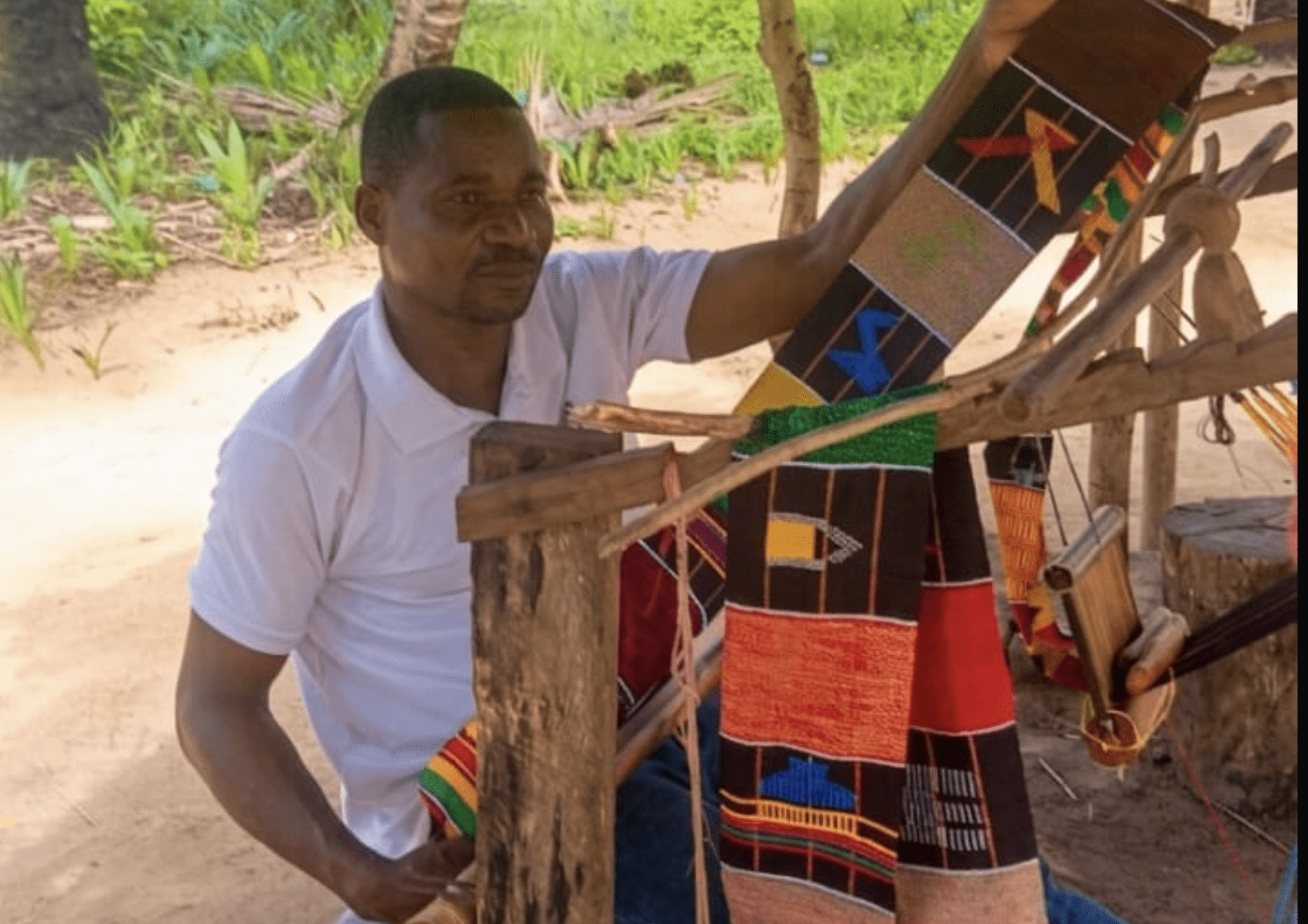
    Master weaver Christian Kofi Hodor at work in his Agotime-Kpetoe workshop
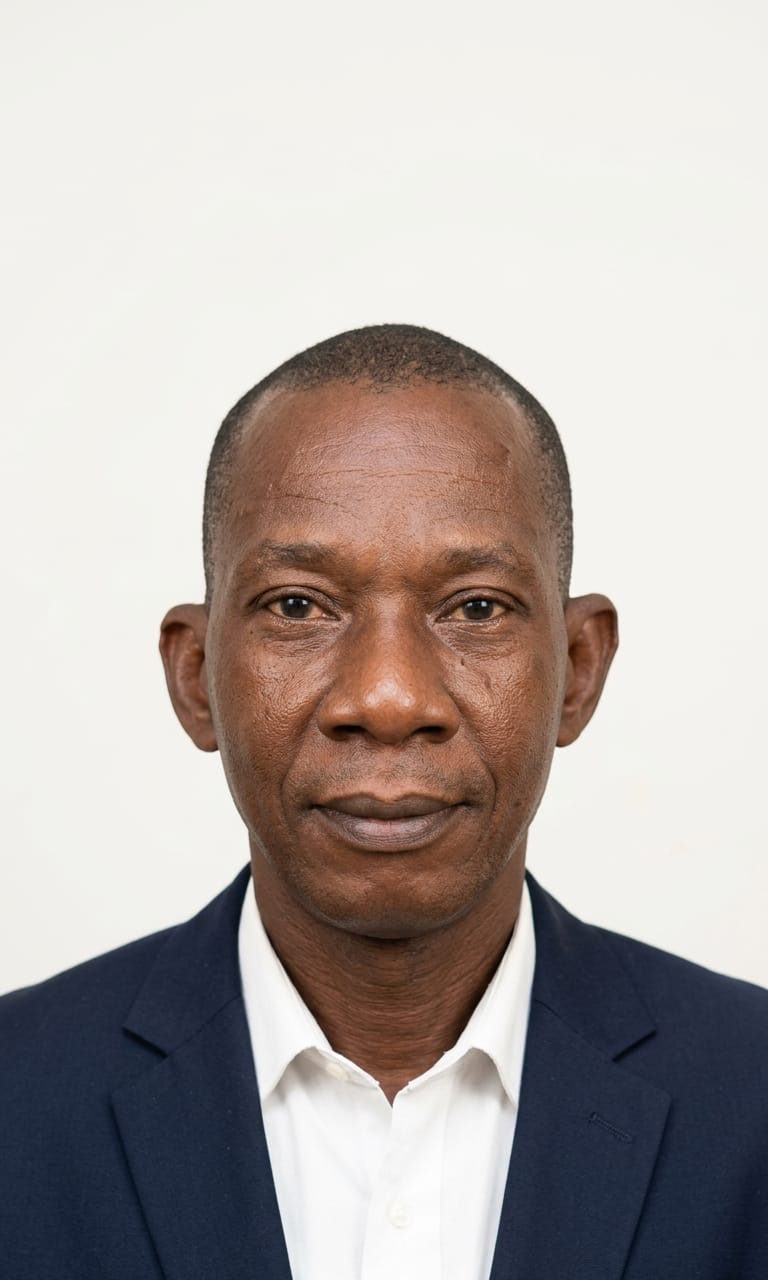
    Master Weaver Christian Kofi Hodor from Agotime-Kpetoe

    In the town of Agotime Kpetoe, in Ghana’s Volta Region, the craft of weaving carries a weight that outsiders often fail to grasp. Weaving here goes beyond ornament or commodity. Instead, it represents the visible form of a people’s understanding of themselves, their history rendered in thread, their pride made wearable.

    Christian Kofi Hodor, born in September 1961, belongs to this tradition not as someone who simply chose it, but as one to whom it fell by birthright. For seven years, he trained under his late master, Mr. Animli, moving through the full vocabulary of Agotime weaving. During that time, he learned its structures, its naming conventions, and its unwritten protocols of pattern and colour. Above all, this extended apprenticeship gave him more than preparation for independent work. It shaped his mind, slowly building the ability to hold forms in the loom and see them through to completion.

    In 1981, he began weaving independently. Over the four decades since, he has built a body of work that bears the unmistakable signature of an original hand. Every design originates from his own imagination, conceived in thought, executed in the loom, and given a name that carries meaning within the community. Notably, chiefs at Kente festivals have worn his cloths, among them Nene Akoto Sah. In a tradition where cloth and chiefly identity remain inseparable, such recognition goes beyond ceremony. Rather, it signals true acknowledgement.


    Recognition & Awards

    Xexia Me Do Atsor Kente cloth woven by Christian Kofi Hodor
    The Kente (kete) cloth the weaver called “Xexiamɛ Dɔatsɔ” in Ewe. In English, the name means, “The World is Beautiful.”

    One design, in particular, has transcended the annual cycle of festival display and entered the permanent record of Kpetoe’s weaving culture: Xexiamɛ Dɔatsɔ. In English, the name means, “The World is Beautiful.” This cloth won prizes at the Kente Festival in consecutive years, 2014 and 2015. Such recognition speaks to a design of unusual coherence and depth.

    Moreover, the festivals at Agotime Kpetoe are not peripheral events that celebrate craftsmanship in the abstract. On the contrary, they serve as the primary arena where the community’s weavers face assessment by one another, by their chiefs, and by the wider public. As a result, an award at these festivals carries real weight. It represents a verdict, not just an honour.


    Craft & Specialisation

    Within the weaving community, fellow weavers identify Mr. Hodor as one of its finest “writers.” In Kente culture, this term carries considerable precision. Specifically, a writer possesses the skill to render words, symbols, maps, animals, and human figures directly into the cloth’s structure. This demanding work goes beyond the abstract. In essence, it requires representational skill of the highest kind.

    While most weavers work with geometric patterns that follow the weave structure’s inherent logic, a writer must hold representational forms in both mind and loom at once. For example, a line drawn by hand on paper becomes a series of choices about which thread passes over and which passes under. Similarly, a bird’s wing, a map’s border, or a human profile must each take shape from within the fabric, strip by narrow strip. Only when the weaver assembles the full cloth do these forms become visible. Few weavers practise this demanding technique.

    Mr. Hodor’s range of woven forms is considerable. His work includes inscriptions woven directly into the cloth, cartographic outlines, figurative animals, human silhouettes, and symbolic devices. Furthermore, the meanings of these devices shift between the literal and the ceremonial. Each form begins as an idea, then becomes a series of structural calculations, and finally emerges as cloth.


    On the Craft and Its Future

    Mr. Hodor speaks of Kente not only as a livelihood but also as a carrier of collective identity. Through this art form, the history and pride of the Agotime people become visible and wearable, passing from hand to hand through generations. Importantly, he avoids speaking of tradition in the language of nostalgia. Instead, he describes it as a living thing that requires active support to stay alive.

    At the same time, he remains frank about the pressures facing weavers today. Reliable buyers are hard to find. Both domestic and international markets remain thin. Consequently, a craft requiring years of formation risks losing its next generation to work that pays more immediately and demands less patience. Over the years, he has watched these pressures narrow the circle of active weavers, and he understands what stands at stake.

    Despite these challenges, he maintains a clear-eyed perspective rather than a pessimistic one. In his view, the cloth needs better promotion, and its cultural significance deserves wider communication beyond Ghana’s boundaries. Likewise, he argues that weavers deserve better support, not as museum pieces, but as living practitioners of a living craft. He also encourages young people to learn the art, not as a gesture toward the past, but because he recognises a crucial truth: once a living tradition breaks, the knowledge it carries does not easily reconstitute itself. Some losses, after all, are permanent.


    In the Registry

    The Kente Registry documents Christian Kofi Hodor’s work as part of our commitment to preserving the living record of Kente weaving. As a result, his designs, training lineage, technical specialisations, and role within the Agotime Kpetoe weaving community now form part of a permanent, authenticated record. Researchers, future weavers, and anyone who wishes to understand this tradition’s depth and sophistication can access it freely.

    The Registry exists precisely for this purpose: to ensure that masters like Mr. Hodor see their knowledge recorded, honoured, and made available to those who come after.


    KenteRegistry.org – RECORDING THE WEAVERS, DESIGNS, AND CLOTHS OF KENTE FOR ALL TIME