- Cloth Name
- Fourth Republic of Ghana
- Registry No.
- KR-D-2026-15046
- Origin
- Agotime-Kpetoe, Volta Region, Ghana
- Weaver
- Master Weaver Gator Gbogbo
- Tradition
- Ewe (Agotime-Kpetoe)
- Pattern Family
- Figural & Commemorative
- Signature Pattern
- Cartographic figural composition (singular work)
- Typical Use
- Commemorative · Not for ceremonial or daily wear
- First Recorded
- circa 1997 · Research in progress
- Provenance
- Workshop of Master Weaver Gator Gbogbo, Agotime-Kpetoe
Status Note: Documentation of this cloth is ongoing. The date of weaving is recorded by the artisan as falling within the early years of Ghana’s Fourth Republic, with circa 1997 the working attribution. Kente Registry welcomes additional documentation, including photographs of the cloth in use, exhibition history, and the weaver’s own recollections.
Pattern & Design Analysis
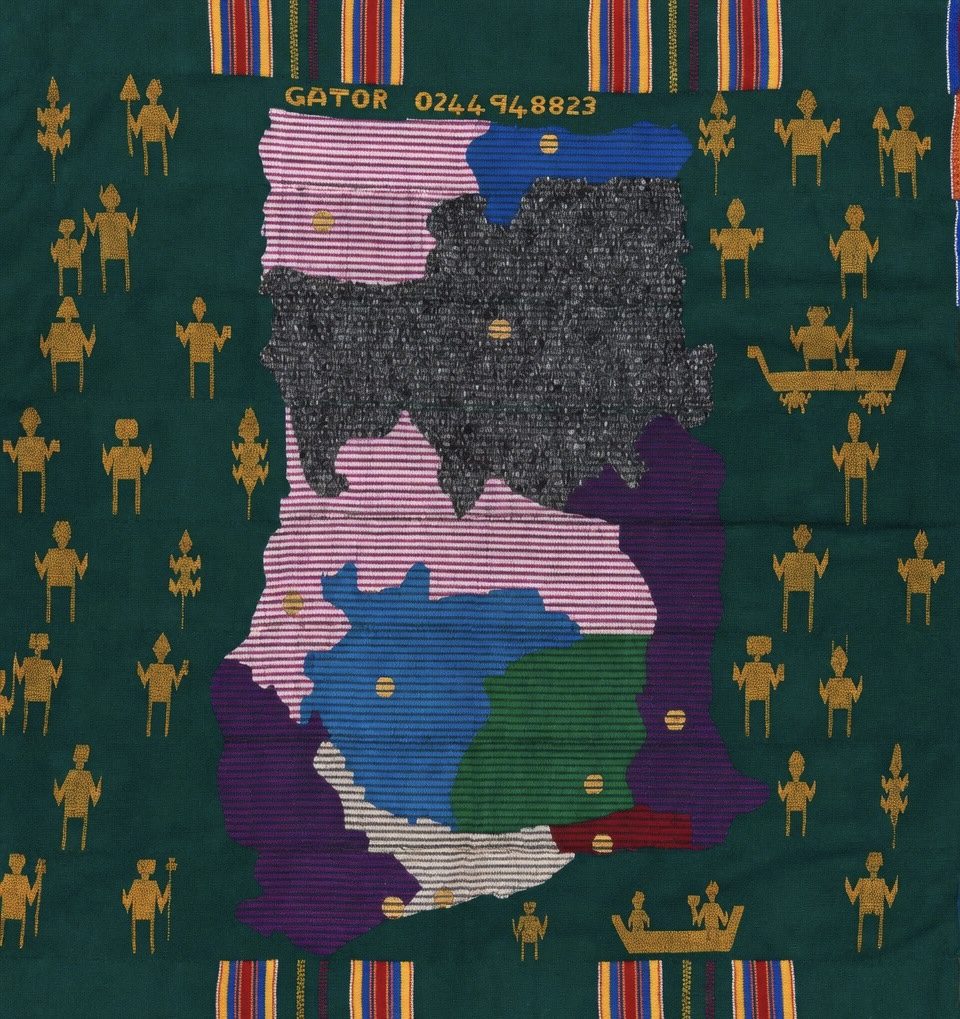
Primary Composition: A singular figural cloth woven in the outline of the Republic of Ghana.
Pattern Meaning & Etymology: Unlike traditional named patterns drawn from proverb, lineage, or court ceremony, Fourth Republic of Ghana is a contemporary commemorative composition. Its title refers to the constitutional era inaugurated on 7 January 1993, which restored civilian democratic government to Ghana after a period of military rule. The cloth is not a repeating pattern in the classical sense; it is a one-of-one cartographic statement, conceived and executed as a unified picture-cloth.
Visual Description & Technical Detail
The piece departs from the rectangular convention of strip-woven Kente. Its silhouette traces the national borders of Ghana, transforming the woven object itself into a map. The surrounding field is a deep, even green — the colour of forest and farmland — and is bordered along its upper and lower edges with vertical bands of red, gold and dark thread, in the manner of Ewe Agotime-Kpetoe selvedges.
Within the green field, scattered across the surrounding territory, are numerous small golden-yellow human figures, each rendered in a slightly different attitude. Several appear to hold staffs or implements of office; others stand in postures of greeting, work, or watchfulness. Read together they form a population — a citizenry — encircling the nation they constitute.
Two small canoe-like vessels, woven in gold, sit upon the green field to the east of the map. They carry standing figures, and may be read as references to inland and coastal waterways — the Volta and the Atlantic seaboard — and to the older histories of trade, fishing and movement that those waters carry.
The map itself is composed in coloured patchwork, each region distinct:
- Northern regions: predominantly black and grey, with subtle textural accents.
- Upper belt: pale pink and lavender stripes.
- Central and western Ghana: bold blue, suggesting the great lake and the rivers.
- South-western corner: vivid green, the forest belt.
- South-eastern and coastal areas: purple and red accents marking the Volta basin and the seaboard.
Small circular gold motifs are woven through the map sections, lending highlights and a quiet symbolic value — reading variously as towns, light, or wealth held in common.
Across the upper edge of the map, in woven yellow capital letters, runs a single inscription:
GATOR 0244 948823
The inscription is the weaver’s own name and Ghanaian telephone number, woven directly into the cloth. It is an extraordinarily rare gesture in the Kente tradition, where the maker’s hand has historically been recognised through pattern, technique and lineage rather than literal signature. Here, the artisan claims the work as unmistakeably his — and offers, with disarming directness, a means of being reached.
Visual Documentation
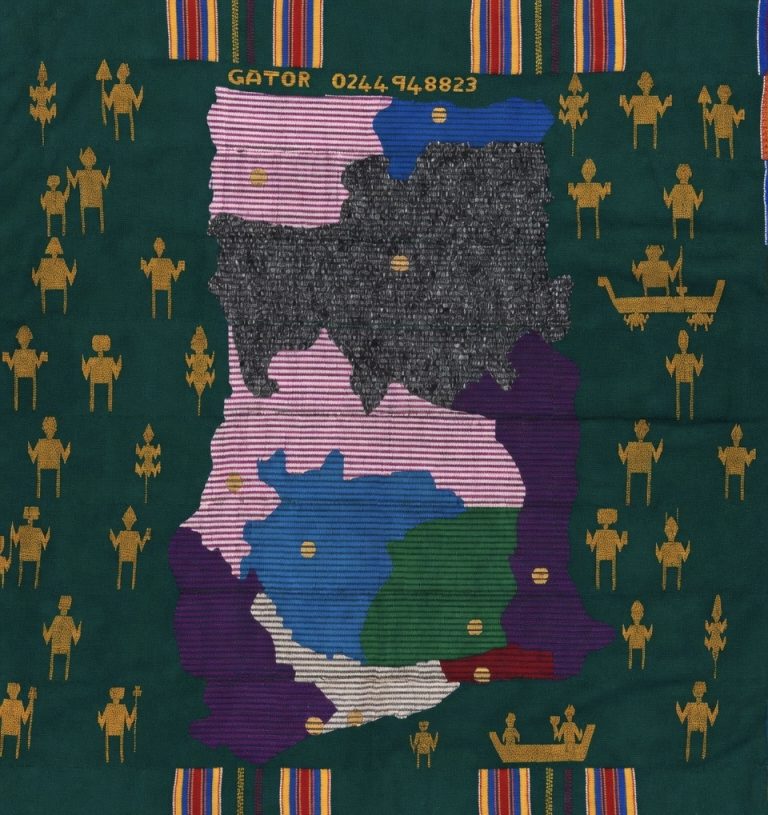
Primary Image: Full view of the cloth, showing its cartographic silhouette, regional patchwork, surrounding figures and woven inscription.
Image Analysis Notes: The geometry departs from the conventional strip-and-stitch rectangle of Kente; the work has been finished to the irregular outline of the country, with selvedges turned to follow the borders. This shaping is itself a technical achievement and one of the cloth’s defining features.
Research Notes
Date of weaving: The artisan locates the cloth in the early years of the Fourth Republic. Circa 1997 is recorded as the working date pending further documentation.
Yarns and ground: The cloth is hand-woven on a traditional Ewe horizontal treadle loom. Fibre analysis is in progress; presentation is consistent with cotton ground with rayon and metallic supplementary wefts of the kind in common use among Agotime-Kpetoe weavers in the late 1990s.
Inscription: The woven legend “GATOR 0244 948823” is documented as part of the artwork itself and is treated here as primary evidence of authorship. The Registry records the inscription as a feature of the cloth and does not present it as a present-day point of contact.
Outstanding questions: Original commission or purpose; subsequent owners and exhibition history; whether the work was conceived as a singular piece or as the first of a small commemorative series. The Registry welcomes correspondence from anyone holding documentation that bears on these questions.
Cultural & Historical Significance
Kente, in its older Asante and Ewe forms, has always been a carrier of meaning. Pattern names invoke proverbs, court histories, family compacts and the moral weight of office. Fourth Republic of Ghana stands within that tradition while extending it: the medium has been turned to speak directly of the nation as a whole.
The choice to render the cloth as the outline of Ghana is not incidental. It is a claim that the country itself can be carried, worn, displayed — that its sovereignty and integrity are matters of common possession. The patchwork of regions reads as a quiet statement of pluralism: north and south, forest and savannah, lake and seaboard, each given its own colour and texture, each bound within a single woven body.
The small golden figures encircling the map carry their own argument. They are unnamed and individually unremarkable, but they are many, and they are within the cloth’s territory rather than outside it. They are the citizens whom the Republic exists to serve.
The inclusion of the weaver’s own name and number, woven in the same yellow as the figures and the boats, is the cloth’s most contemporary gesture. It refuses anonymity. It places the artisan within the work as fully as any of the figures around the border — an act of authorship that is also an act of citizenship.
Connections to the Kente Registry
This profile sits within the Registry alongside the working record of its weaver, Master Weaver Gator Gbogbo of Agotime-Kpetoe. Cross-references to related cloths and to the wider Ewe weaving tradition will be added as the corpus grows.
Fourth Republic of Ghana is recorded by the Registry as a singular figural work. It is preserved here as part of the documentary record of contemporary Ewe Kente: an artefact in which traditional technique, national feeling, and personal authorship are held together in a single woven body.
Credits & Acknowledgements
The Weaver

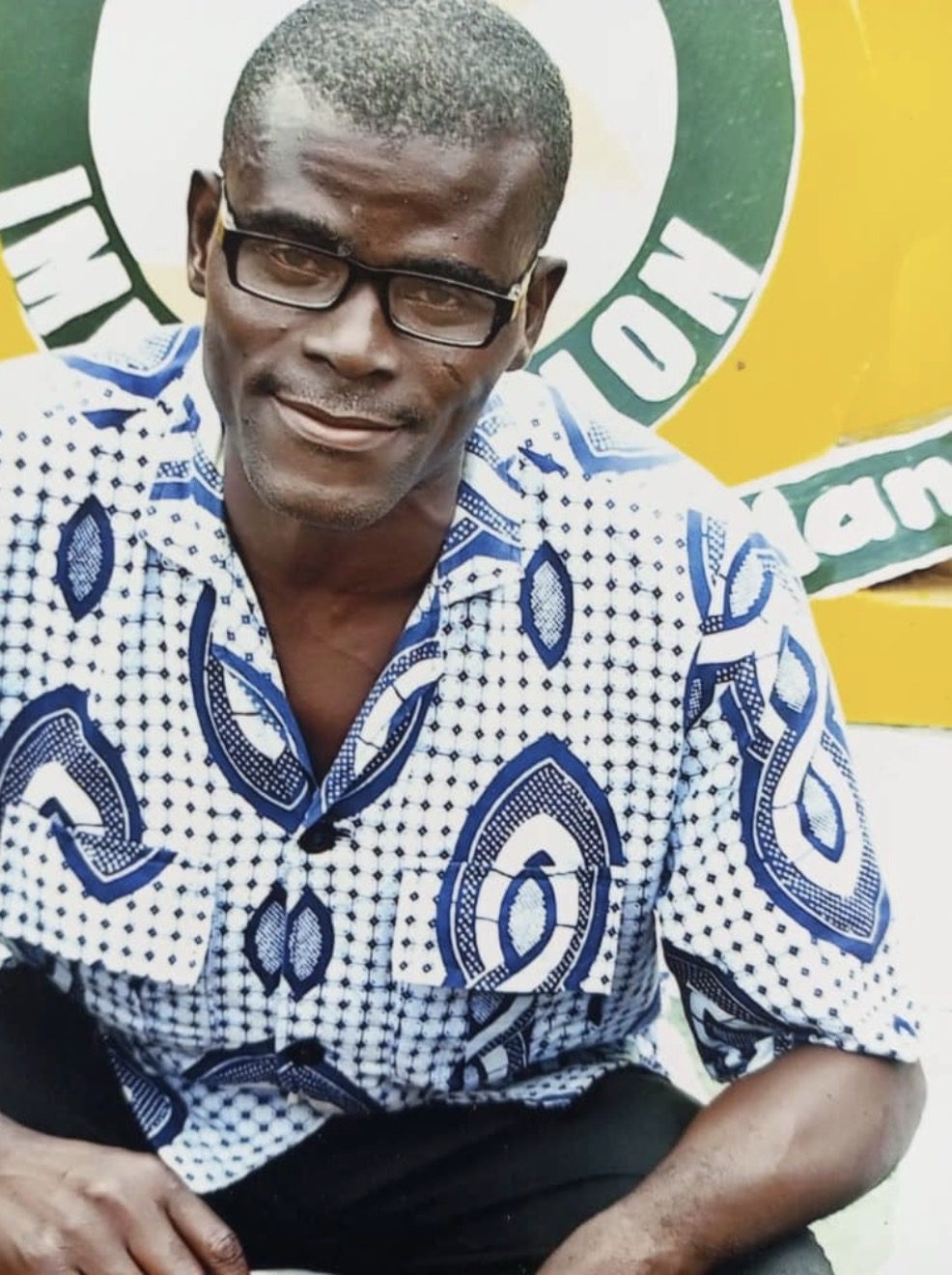
Master Weaver Gator Gbogbo works in the Ewe weaving tradition of Agotime-Kpetoe in Ghana’s Volta Region, an area long recognised for figural and symbolic Kente. Fourth Republic of Ghana is among the most ambitious works in his recorded output: a singular, sculptural cloth that joins technical mastery with an unusually direct civic and personal statement.
Documentation & Photography
Photography and documentation: Kente Registry. Cloth and weaver photographs are held in the Registry’s archive.
Citation
Fourth Republic of Ghana, Master Weaver Gator Gbogbo, Agotime-Kpetoe, circa 1997. Kente Registry, KR-D-2026-15046.
Attribution and sources
Sources
- Field interview with Gator Gbogbo, Agotime-Kpetoe, 16 April 2026.
- Audio interview with Gator Gbogbo, 18 April 2026, Kente Registry archive (unedited).
Information provided by
- Gator Gbogbo , Master weaver , 16 April 2026 . In-person field interview, Agotime-Kpetoe
- Gator Gbogbo , Master weaver , 18 April 2026 . Post-fieldwork audio interview, Kente Registry archive