
- Cloth Name
- Susudua — “Measuring Stick”
- Registry No.
- KR-D-2026-15048
- Origin
- Bonwire, Ashanti Region, Ghana
- Weaver
- Unknown · Research in progress
- Pattern Family
- Prestige cloths
- Signature Pattern
- Susudua (measuring-stick)
- Typical Use
- Worn by all · Ceremonial and everyday
- First Recorded
- Early to mid-20th century
- Holding Institution
- Cooper Hewitt, Smithsonian Design Museum
- Accession Year
- 1969
- Department
- Textiles
- Provenance
- Research in Progress
Provenance
The weaver’s identity is undocumented. The cloth is held by Cooper Hewitt, Smithsonian Design Museum, where it was acquired in 1969 and photographed by the museum in 2013. It is dated early to mid-20th century. The medium is viscose rayon, hand-loomed in plain weave with discontinuous supplementary weft patterning.
Beyond these facts from Cooper Hewitt’s accession record, attribution remains open. The cloth almost certainly originates from the artisan community in Bonwire that has long woven in service to the Asante royal court, but no individual weaver has been identified. Kente Registry welcomes additional documentation from researchers, descendants of Bonwire weavers, and cultural historians who may help illuminate this cloth’s origins.
The Susudua pattern
The name carries its own technical instruction. Susudua is the Akan word for the measuring stick the weaver uses to align each pattern block. The cloth is woven in continuous narrow strips that are later cut and sewn together; without careful alignment the checkerboard design would not meet across the seams. The pattern is named for the tool that makes it possible.
Cooper Hewitt’s accession record, drawing on Malika Kraamer’s scholarship in African Arts (Kraamer, “Ghanaian Interweaving in the Nineteenth Century: A New Perspective on Ewe and Asante Textile History,” African Arts 39, no. 4), describes the cloth as composed of three patterning systems working together: a balanced-weave check that forms the structural base, weft-faced stripes that provide secondary patterning, and supplementary weft zigzags that produce the small geometric motifs within each block. The interplay of these three systems is what distinguishes Susudua from simpler kente compositions.
What the photograph shows
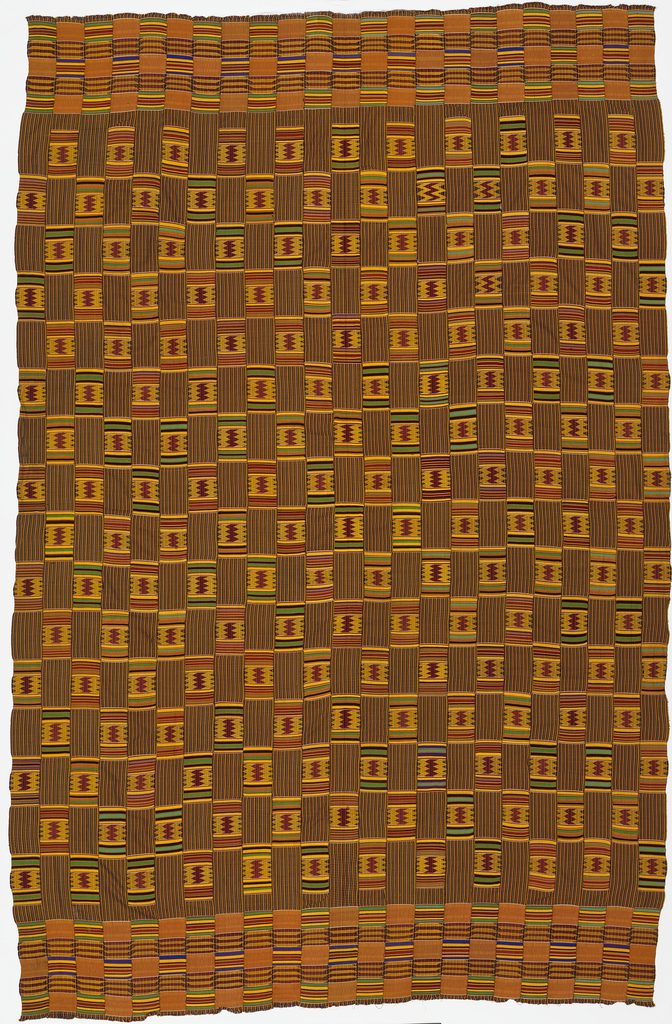
The cloth presents a checkerboard of rectangular blocks in warm golden-brown and rust tones, with red-orange and olive-green supplementary weft accents. Each block contains a small zigzag or diamond motif. The blocks sit on a vertically striped background, the balanced-weave check, and are framed at top and bottom by bold horizontal borders in the same warm palette.
The viscose rayon medium gives the cloth a subtle sheen visible in the museum’s photograph, distinguishing it from earlier plant-fibre kentes while preserving the visual richness expected of a prestige cloth.
Research in progress
Several questions remain open and the registry continues to research them.
The weaver. No individual attribution exists. Workshop attribution within Bonwire’s artisan community would also be informative if the cloth can be linked to a specific weaving lineage.
Dating. Cooper Hewitt dates the cloth to the early to mid-20th century. Material analysis or comparison with dated examples might narrow this range further.
Donor and acquisition pathway. The cloth was acquired by Cooper Hewitt in 1969. A donor name has appeared in earlier draft documentation of this record but has not yet been verified against Cooper Hewitt’s published accession data and is omitted here pending confirmation. Researchers with access to Cooper Hewitt’s donor records are invited to assist.
Contributions of oral history, archival material, or scholarly analysis bearing on any of these questions are welcomed at the registry.