
Tag: Weaving Techniques

  • The Language of Kente: Decoding the Patterns, Colours, and Their Meanings

    The Language of Kente: Decoding the Patterns, Colours, and Their Meanings

    Every strip of Kente is a sentence. Every cloth is a speech. To wear it without understanding it is to speak without knowing what you are saying.

    Imagine receiving a letter written in a language you do not speak. The letters are beautiful, the ink rich, the paper fine. You can admire the penmanship. You can recognise that something important has been written. But you cannot read it. Now imagine learning the language. Suddenly the letter transforms. What was surface becomes substance. What was pattern becomes meaning. What was admirable becomes profound.

    This is the experience of encountering Kente. For millions of people who see it, wear it, and celebrate it, Kente is a beautiful object. But for the Ewe and Ashanti people of Ghana who created it, Kente is a text, dense with vocabulary, rich with grammar, specific in its declarations.
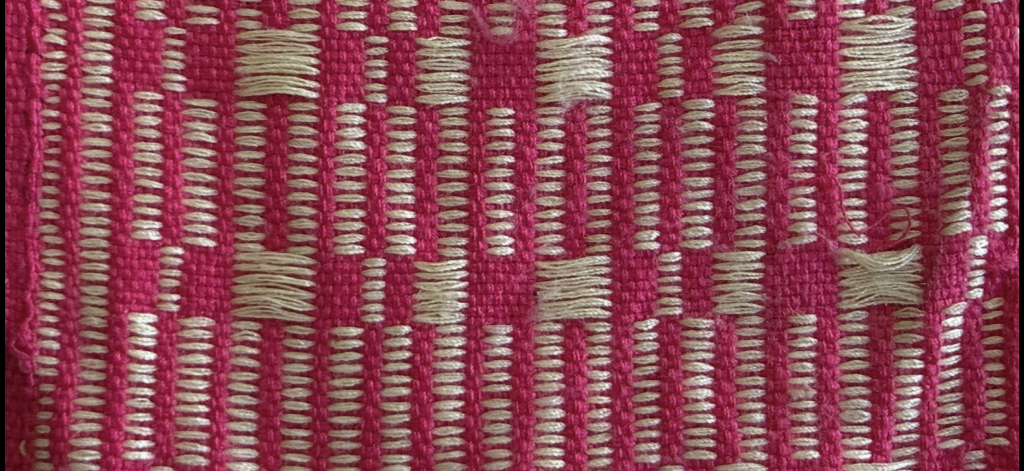
    Pink Kente

    The Grammar of Colour

    The first element of Kente’s language is colour. In the Kente vocabulary developed by the Ewe and Ashanti weavers of Ghana, each colour carries a specific and culturally agreed meaning.

    Gold (and yellow): The colour of royalty, wealth, and moral authority. Gold in Kente does not simply represent material richness but the earned status that comes with wisdom, integrity, and service to the community. It is the colour of the Ashanti Golden Stool, the spiritual heart of the nation.

    Green: The colour of growth, renewal, and the living earth. Green represents fertility, both of the land and of the family, and carries associations with the agricultural rhythms that have always underpinned Ghanaian life.

    Black: Perhaps the most misunderstood colour in the Kente vocabulary for those unfamiliar with its tradition. Black does not signify mourning or negativity. It represents spiritual maturity, the wisdom of age, and the protective power of the ancestors.

    White: The colour of purity, healing, and the sacred. White is associated with the spiritual dimension of life, with cleansing ceremonies, and with the relationship between the human and the divine.

    Blue: Peace, harmony, and love. Blue in Kente carries the qualities of water, which in Ghanaian spiritual tradition is associated with life-giving force, with the smoothing of conflict, and with the deep bonds of family and community.

    Red: Used sparingly and deliberately, red carries the weight of political authority, sacrifice, and the blood of those who gave their lives for the community. It is a serious colour, deployed when the occasion demands acknowledgment of struggle, sacrifice, or the gravity of leadership.

    Silver: Associated with the moon, with serenity, and with purity in its cosmic dimension. Silver appears in Kente when the weaver wishes to invoke a quality that transcends the everyday.

    The Vocabulary of Pattern

    If colour is the vocabulary of Kente, pattern is its syntax. There are hundreds of distinct Kente patterns, each with a name, an origin, and a precise cultural meaning.

    Adweneasa is perhaps the most celebrated pattern in the Kente repertoire. Its name means “my skills are exhausted,” and it represents the pinnacle of a weaver’s technical achievement. A cloth woven in Adweneasa declares that the weaver has given everything they have. It is worn at moments of supreme achievement and is associated with the Ashanti royal court.

    Sika Futuro means “gold dust” and is associated with wealth, prosperity, and the moral quality of the person who has earned it honestly. It is often worn by leaders and successful people as a declaration of both material success and the integrity with which that success was achieved.

    Emaa Da, meaning “it has never happened before,” is a pattern reserved for unprecedented achievements and historic moments. It celebrates the first, the groundbreaking, the extraordinary. When Ghana achieved independence in 1957, Emaa Da was among the patterns worn to mark the occasion.

    Asasia is a royal pattern, reserved in tradition for chiefs and kings. Its geometric structure communicates the order and authority that good governance requires. To wear Asasia without royal entitlement was historically considered a serious transgression of social order.

    Oyokoman takes its name from the royal clan of the Ashanti and is associated with danger survived and safety restored, communicating the resilience of those who have faced adversity and come through it with their character intact.

    Kubi is associated with aristocratic leadership and the responsibilities of those in authority. It speaks of the obligation of the powerful to serve those they lead, embedding the ethics of governance into the very cloth worn by those who govern.

    The Occasion Speaks Through the Cloth

    Beyond colour and pattern, a third dimension of Kente’s language is occasion. The specific cloth worn to a naming ceremony is different from the one worn to a funeral. An experienced Ghanaian observer reads all three dimensions simultaneously: what colours have been chosen, what patterns woven, and what occasion is being marked.

    Understanding these dimensions of Kente’s language transforms the experience of seeing it. What might appear to an uninformed observer as a beautifully coloured cloth reveals itself as a specific and intentional act of communication, addressed to a community that knows how to read it.

    Why Learning the Language Matters

    There is a practical reason to learn Kente’s language, and a moral one. The practical reason is simple: understanding what you are wearing or displaying allows you to wear or display it appropriately. A pattern reserved for royalty worn casually to a party is not a neutral act.

    The moral reason is deeper. Kente has become a global phenomenon. If all those people engage with Kente purely as visual spectacle, admiring its surface while remaining ignorant of its depth, something important is lost. The culture is flattened. Its meaning is erased in the very act of its celebration.

    But if even a fraction of those millions take the time to learn something of what Kente means, genuine appreciation replaces superficial admiration. And the weavers of Ghana, who have invested their lives in the transmission of this knowledge, see that investment honoured in the way it was always meant to be: through understanding.

    Kente was designed to be read. It is time the world learned to read it.
  • The Unsung Heroes: Meet the Weavers Behind the World’s Most Iconic Fabric

    The Unsung Heroes: Meet the Weavers Behind the World’s Most Iconic Fabric

    They did not weave to be remembered. They wove because it was right, because it was true, because their people needed it.

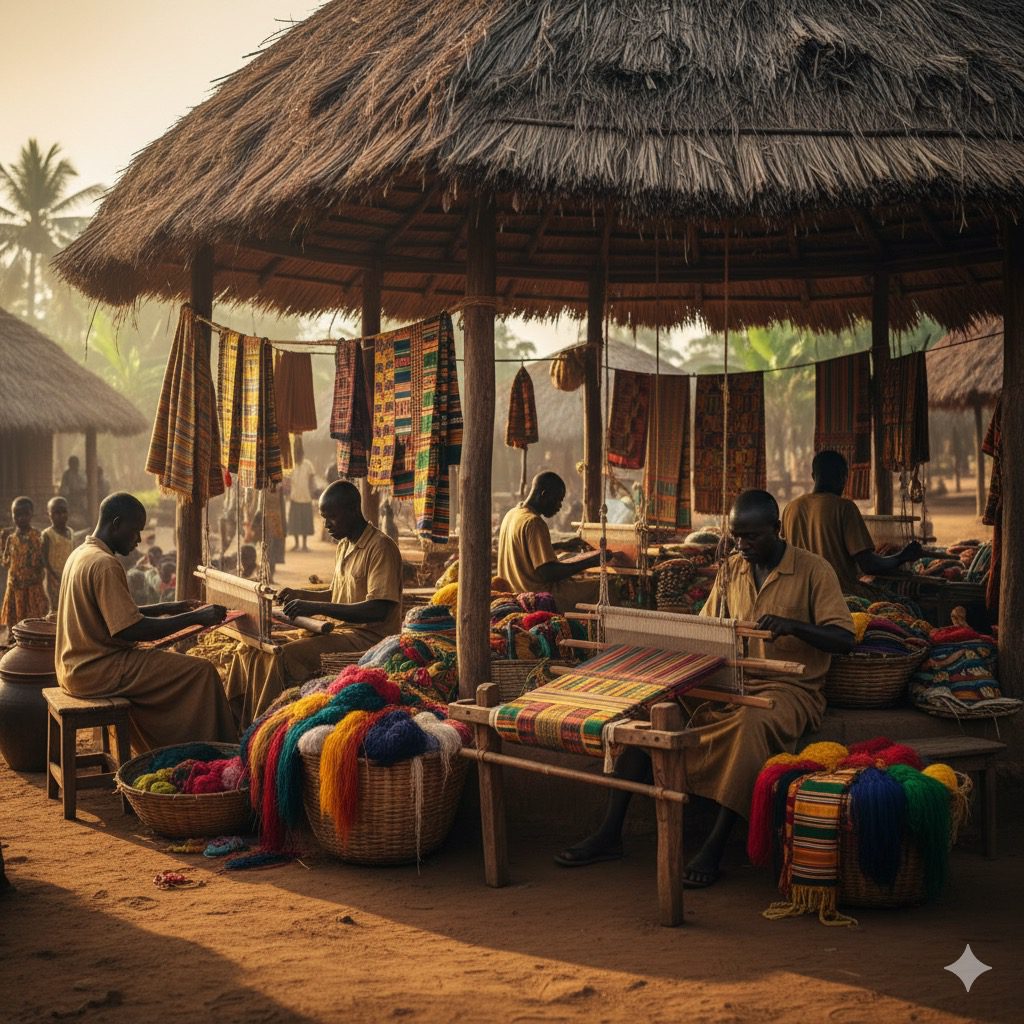
    There is a man sitting at a loom in Bonwire, Ghana. He is not young. His hands move with the unhurried certainty of someone who has performed this motion ten thousand times before, and who knows he will perform it ten thousand times again. He does not look up when visitors pass. He does not pause to explain what he is doing or why. The work is its own explanation. The cloth growing beneath his hands has been growing, in one form or another, for centuries. He is simply the latest in a line so long it disappears into the mist of Ghanaian antiquity.

    This man is a Kente weaver. And in all likelihood, you have never heard his name.

    That is not an accident. It is, in many ways, a reflection of how the weavers themselves have always understood their role. From the earliest days of Kente’s history among the Ewe and Ashanti people of Ghana, the weavers who created this magnificent textile did not position themselves as artists seeking recognition. They positioned themselves as servants of something larger: their communities, their traditions, their ancestors, and their God. The cloth was the point. The weaver was the instrument.

    But we live in a different age now. And that difference carries with it a responsibility we have not yet fully accepted.

    Ancient Hands, Ancient Humility

    The story of Kente weaving as told by Ashanti oral tradition begins not with a master craftsman announcing his genius to the world, but with two young men watching a spider. Observing the web of Anansi with quiet attention, they attempted to replicate its structure using fibres from a palm tree. What they created, they brought not to a market to sell, but to their king, Asantehene Osei Tutu I, as an offering. They did not seek fame. They sought to honour.

    This founding act of humility set the tone for everything that followed. For generations upon generations, Kente weavers in the communities of Bonwire and Adanwomase in the Ashanti Region, and in the Ewe weaving towns of Kpetoe and Agotime in the Volta Region, have practised their craft with the same quiet devotion. They learned at their fathers’ feet, or their uncles’, sitting beside the narrow-band loom as children, learning to read the patterns before they could produce them, memorising meanings before their hands were strong enough to weave.

    The Weight of What They Carry

    To appreciate what these weavers do, it is important to understand the technical and intellectual demands of the craft. Kente weaving is not simple work. It is not the kind of skill acquired in a weekend course or mastered through casual repetition. It is a discipline that demands years of dedicated study, an encyclopaedic knowledge of hundreds of distinct patterns and their meanings, and a physical dexterity that must be built slowly and maintained constantly.

    The traditional narrow-band loom on which Kente is woven produces strips of cloth roughly four inches wide. These strips are then cut and sewn together with extraordinary precision to create the full cloth, ensuring that patterns align perfectly across every seam. A master weaver working on a complex commission may spend weeks on a single cloth, holding in their mind simultaneously the full visual design, the symbolic meaning of each section, and the technical requirements of the loom.

    The patterns themselves are a form of intellectual property, passed down through lineages with the same care as land or gold. Some patterns belong to specific families and may only be woven by their members. Others are reserved for royalty and may only be commissioned by chiefs and kings. A weaver who produces a reserved pattern without authorisation does not simply make a mistake. They commit a cultural transgression.

    What Has Changed, and What It Demands of Us

    For most of Kente’s history, the invisibility of the weaver was simply the way things were. Information moved slowly. Communities were smaller. The weaver was known in their village, respected in their town, honoured by the chiefs who commissioned their work. That local recognition, though it never extended to global fame, was sufficient within its context.

    That context has changed completely. We live now in a world of unprecedented connectivity. A photograph taken in Bonwire this morning can be seen in London, Lagos, and Los Angeles before nightfall. The same global visibility that has allowed Kente to become one of the most recognised textiles on earth has also created a profound imbalance. The cloth is celebrated everywhere. The people who make it are celebrated almost nowhere.

    Exercising Good Judgment: How to Honour the Weavers

    Name them. When Kente is featured in a publication, a fashion spread, an academic paper, or a social media post, name the weaving community it came from. Name the town. If possible, name the weaver. A cloth attributed to its source is a cloth that carries dignity.

    Seek out authentic work. Every purchase of genuine, handwoven Kente from an Ewe or Ashanti weaver is a vote cast for the continuation of the tradition. Every purchase of a machine-made imitation is a vote cast against it.

    Amplify their stories. The weavers of Bonwire and Kpetoe and Adanwomase have stories worth telling. There are elderly masters who carry in their minds patterns that exist nowhere else. There are young weavers who have chosen the loom over other paths, committing to a tradition that the modern world constantly tempts them to abandon.

    Support institutional recognition. The Kente Registry and similar initiatives represent the kind of structural change that can embed the weavers’ contribution into the legal and cultural record permanently.

    The Loom Is Still Running

    Somewhere in Ghana right now, a Kente weaver is at work. The shuttle moves. The patterns accumulate, strip by strip, colour by colour, meaning by meaning. The cloth that will emerge from that loom will go on to mark a birth, or a marriage, or a funeral, or a graduation. It will be photographed and admired and worn with pride. It will travel, perhaps, to another continent entirely, where someone will see it and feel something stir in them, some recognition of beauty and depth that transcends the distance between where they stand and where it was made.

    The weaver will not be in that photograph. Their name will likely not appear in the caption. But their hands will be in every thread, their knowledge in every pattern, their devotion in every colour.

    It is time the world learned to see them. The greatest artistry is often the quietest. The Kente weavers of Ghana have known this for centuries. Now it is our turn to know it too.