In Ghana, Kente is not worn. It is spoken. It is not fabric. It is a declaration.
Ask any Ghanaian what Kente means to them, and you will rarely receive a simple answer. They may speak of their grandmother draping it across her shoulder at a funeral, of the pride that swelled in their chest the first time they wore it to a naming ceremony, of the way it transforms an ordinary person into something ceremonial, something seen and recognised by the world. Kente, the hand-woven masterpiece of the Ewe and Ashanti people of Ghana, is one of the few objects on earth that carries within its threads an entire civilisation’s understanding of beauty, meaning, and belonging.
To speak of Kente as fabric alone is to miss the point entirely. Thread and loom are merely the medium. The message is something far older, far richer, and far more alive than any single garment could contain. Kente is identity. It is communication. It is the language that Ghanaians speak when words are insufficient for the gravity of a moment. It is present at the beginning of life and at the end of it, at the height of joy and in the depths of mourning, at royal courts and at village squares. It belongs to everyone and is sacred in its own right.
A Living Language Woven in Thread
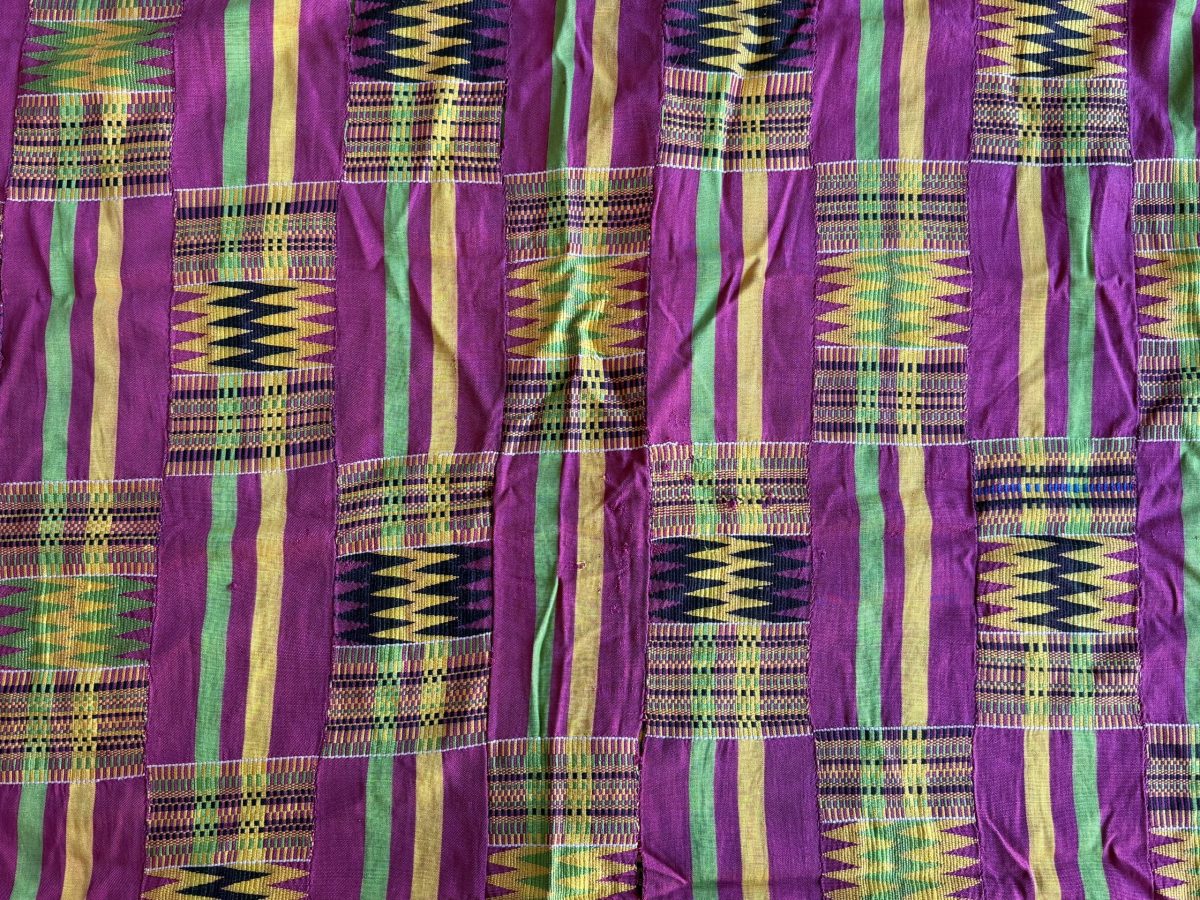
The most important thing to understand about Kente is that it is not decorative. Every element of a Kente cloth, from the colours chosen to the geometric patterns selected, carries deliberate meaning. The Ewe and Ashanti weavers who produce it are not simply craftspeople. They are communicators. They are historians and philosophers, encoding in each strip of cloth the wisdom, values, and spiritual convictions of their people.
Each colour in the Kente vocabulary tells a story. Gold speaks of royalty, wealth, and the moral authority that comes with earned achievement. Green carries the energy of renewal, of the earth’s abundance, of growth and fertility. Black, far from being a colour of mourning in the Western sense, represents spiritual maturity, the power of the ancestors, and the deep intelligence that comes with age. White signifies purity, healing, and the sacred. Blue speaks of peace, harmony, and the love that holds communities together. Red, used sparingly, carries the weight of political authority, sacrifice, and the blood of those who came before.
The patterns, too, are a vocabulary. There are hundreds of distinct Kente designs, each with a name drawn from proverbs, historical events, or philosophical ideals. Adweneasa, meaning my skills are exhausted, is a pattern of such complexity that a weaver declares it a summit of their craft. Emaa Da celebrates the unprecedented, the moment that has never happened before. Sika Futuro, gold dust, celebrates wealth earned with integrity. To wear any of these is not to make a fashion choice. It is to make a statement, and every Ghanaian who sees it reads that statement fluently.
The Companion of Every Occasion
What distinguishes Kente from the ceremonial textiles of other cultures is its remarkable range. It does not belong exclusively to one kind of moment. It is not reserved only for the sacred, nor confined to celebration. In Ghana, Kente is the chosen companion for the full breadth of human experience, moving effortlessly between the secular and the sacred, the joyful and the solemn, the intimate and the communal.
At birth, a newborn enters the world wrapped in the knowledge of their heritage. The outdooring ceremony, held seven days after birth, is the moment a child is formally introduced to the world. Kente is present. Family members wear it to honour the new life. The colours chosen reflect the hopes held for the child, the prayers offered to the ancestors for their protection.
At marriage, Kente becomes one of the most powerful visual symbols of union. A bride and groom dressed in Kente are not simply dressed beautifully. They are declaring before their community, their ancestors, and their God that this union is serious, honoured, and rooted in something larger than themselves.
At funerals, Kente serves as a bridge between the living and the departed. Contrary to what outsiders might expect, funerals in Ghana are often vibrant, elaborate celebrations of a life fully lived. The specific Kente worn at a funeral is selected with great care, communicating the status of the deceased, the grief of the bereaved, and the community’s affirmation that death is not the end but a transition into the company of the ancestors.
At enstoolments and royal ceremonies, Kente reaches its most regal expression. When a chief or king is enstooled, Kente is inseparable from the occasion. The specific patterns worn by royalty are reserved, communicating authority that is not merely political but spiritual.
At graduations and civic celebrations, Kente speaks of pride and achievement. Across Ghana and throughout the African diaspora, graduates drape Kente across their academic gowns as a declaration that their success is not only personal but ancestral, earned on the shoulders of those who came before them and offered forward to those who will come after.
What Kente Means to Ghana as a Whole
For Ghanaians, Kente is not a relic of the past. It is not something to be preserved behind glass in a museum while modern life moves on without it. It is alive. It evolves. New patterns are created by master weavers to mark new chapters in the nation’s history. When Ghana achieved independence in 1957, the occasion was marked in Kente. When Ghana hosts heads of state, dignitaries and presidents are presented with Kente as the highest expression of welcome and honour.
For the Ewe and Ashanti people in particular, Kente is inseparable from identity. The Ashanti, whose royal court in Kumasi gave Kente its first formal expression, see it as a living connection to the Golden Stool, the spiritual heart of the nation. The Ewe, whose distinctive weaving tradition produces patterns of extraordinary complexity, bring to Kente a philosophy of the cosmos expressed in geometric form.
Across the wider Ghanaian community, regardless of ethnicity or region, Kente has become a shared national symbol, one that unites people across lines of language, religion, and geography. A Ga person wearing Kente at a celebration is making the same declaration as an Ashanti elder wearing it at a durbar: I am Ghanaian. I carry this history with pride. I am part of something that stretches back further than I can see and forward further than I can imagine.
Sacred Threads in a Secular World
One of the most remarkable qualities of Kente is its capacity to hold both the sacred and the secular without contradiction. In a world that often insists on separating the spiritual from the everyday, Kente refuses the distinction. It is as comfortable in a church as it is at a naming ceremony. It is as appropriate at a political rally as it is at a queen mother’s court.
This is because, for the Ghanaian worldview from which Kente emerges, the sacred and the secular are not opposites. They are dimensions of the same reality. The ancestors are not distant figures consigned to another realm. They are present participants in the life of the community, honoured at every significant moment. When Kente is worn, the ancestors are acknowledged.
A Thread That Cannot Be Broken
To understand Kente is to understand something essential about Ghana and its people: that beauty and meaning are not luxuries but necessities, that the past is not behind them but beneath them, holding them up, and that every significant moment in a human life deserves to be marked with intention and dignity.
Kente is not worn carelessly. It is not chosen without thought. When a Ghanaian reaches for Kente, they are reaching for something that their grandparents reached for, and their grandparents before them. They are participating in an unbroken act of cultural transmission that has persisted through colonialism, migration, globalisation, and the relentless pressure of a world that often asks people to leave their traditions at the door of modernity.
Ghana has refused. The Ewe and Ashanti weavers of Bonwire and Kpetoe and the great weaving communities across the country have refused. They sit at their looms and they weave. They pass their knowledge to their children. They create new patterns for new times while honouring the depth of what came before. And with every strip of cloth produced, they send the same message forward into the future: we are still here. Our culture is still alive. And it is beautiful.
Kente does not simply clothe the body. It clothes the soul, the story, and the nation. That is why Ghana wears it with such pride, and why the world cannot look away.