When a culture’s most sacred expression is reduced to a cheap imitation, the damage is not only economic. It is a wound to the soul of a people.
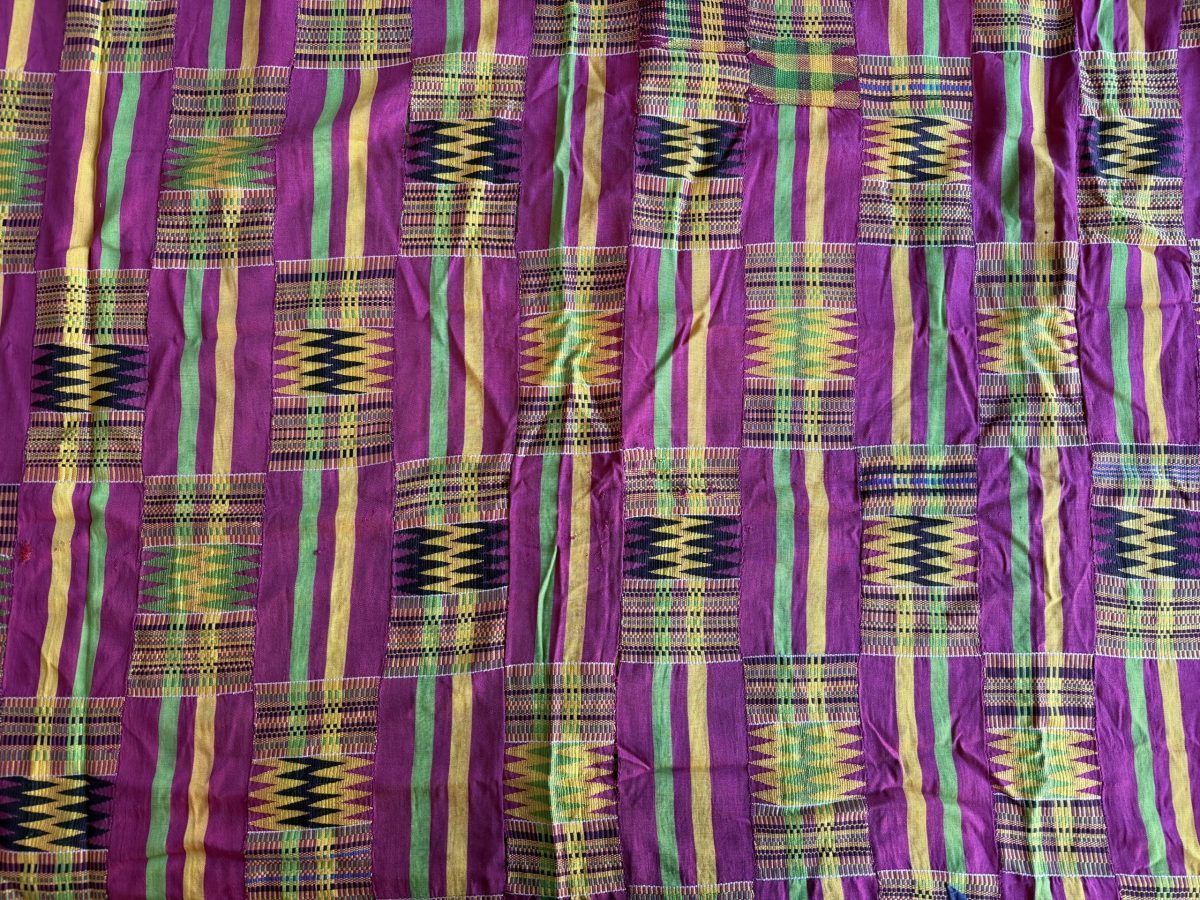
Walk through any large market in West Africa, browse any online platform selling African-themed products, or visit the gift shop of a major international museum, and you will find it: fabric printed with Kente-inspired patterns, labelled boldly and sold confidently as Kente. It is colourful. It is eye-catching. It costs a fraction of what a genuine handwoven cloth would command. And it has nothing to do with Ghana, with the Ewe and Ashanti weavers who created this tradition, or with the centuries of cultural knowledge encoded in every authentic strip.
This is not a minor inconvenience. It is not a harmless side effect of global admiration for a beautiful tradition. It is a form of cultural and economic harm that reaches deep into the lives of real people, the master weavers of Bonwire and Kpetoe and Adanwomase, and into the cultural foundations of an entire nation. The threat is real, it is ongoing, and it demands an urgent and structured response.
The Scale of the Problem
The market for Kente-inspired products is enormous and growing. As Kente’s global profile has risen, driven by its adoption in diaspora graduation ceremonies, its appearance in high fashion collections, and its celebration in popular culture, demand for products carrying its visual identity has expanded dramatically. The overwhelming majority of that demand is being met not by the weavers of Ghana, but by factories in Asia and elsewhere producing machine-made imitations at industrial scale.
These products range from outright counterfeits, fabric marketed explicitly as Kente with no geographical qualification, to more subtle forms of misappropriation, where the patterns are reproduced under different names or described vaguely as African fabric, allowing sellers to benefit from Kente’s cultural cachet without making a claim they can be held to legally.
The Economic Damage to Weavers and Communities
For the weavers of Ghana, the economic consequences of this flood of imitation are direct and severe. Authentic handwoven Kente is labour-intensive to produce. A master weaver working on a complex cloth may spend several weeks completing a single commission, using skills acquired over years of dedicated apprenticeship. The resulting cloth commands a price reflective of that investment, as it should.
But in a market saturated with machine-made alternatives selling for a fraction of that price, many consumers, particularly those outside Ghana who lack the knowledge to distinguish genuine from imitation, will naturally choose the cheaper option. A weaver in Bonwire cannot compete with a factory in Guangzhou on cost. The value of their work lies in its authenticity, its cultural depth, and its artisanal quality, none of which can be replicated by a machine.
The communities built around Kente weaving are also affected. When the economic return on authentic Kente is suppressed by competition from imitations, young people may choose not to invest the years required to master the craft. The result, over time, is the erosion of the very tradition that makes the product worth imitating in the first place.
The Cultural Damage: When Meaning Is Stripped Away
The economic harm, significant as it is, may actually be less damaging in the long run than the cultural harm. Kente is not merely a textile. It is a language. Every pattern, every colour combination, every decision made by a weaver in the construction of an authentic cloth, carries meaning. That meaning is communal, historical, and in many cases sacred.
When a machine-printed fabric reproduces the geometric patterns of Kente without any of the cultural knowledge that underlies them, something important is lost. The patterns are separated from their meanings. The cloth is reduced to its visual surface and stripped of its depth.
More troubling still is what happens when specific patterns, some of which are reserved in Ghanaian tradition for royalty or specific ceremonial contexts, appear on mass-produced consumer goods without regard for their significance. A pattern that in its authentic context speaks of royal authority or sacred ritual, printed on a beach towel or a pair of shorts and sold in a tourist shop, is not simply misused. It is desecrated.
The Threat to Cultural Transmission
There is a third dimension of harm that receives less attention but may carry the gravest long-term consequences: the threat to the transmission of Kente knowledge from one generation to the next.
The knowledge embedded in Kente weaving, the meanings of hundreds of patterns, the protocols governing their use, the techniques required to produce them, is not written down in a comprehensive archive. It lives primarily in the minds and hands of master weavers, many of whom are elderly. It is transmitted through apprenticeship, through the patient accumulation of skills and knowledge over years of close work with an experienced practitioner.
When the economic incentives for entering the weaving tradition are undermined by market competition from imitations, the pipeline of knowledge transmission is threatened. Patterns that have been woven for centuries may eventually be woven by no one. The knowledge dies not with a dramatic rupture but with a quiet, gradual fading, noticed only when it is too late to reverse.
Why a Formal Registry Is the Answer
The solution to these interconnected forms of harm requires something more than goodwill and awareness. It requires structure. It requires a formal, legally grounded mechanism that can document what is authentic, certify who is qualified to produce it, and enforce the distinction in the marketplace. This is precisely what the Kente Registry is designed to provide.
The threat to Kente is real and it is urgent. The knowledge held by the oldest master weavers will not wait indefinitely. The market dynamics that disadvantage authentic production will not self-correct. And the global appetite for Kente-inspired products will not diminish. The window for effective action is open, but it will not remain open forever.
What is at stake is not a product. What is at stake is the living cultural heritage of an entire people. Ghana has everything to gain by protecting it, and everything to lose by waiting.