
They did not weave to be remembered. They wove because it was right, because it was true, because their people needed it.
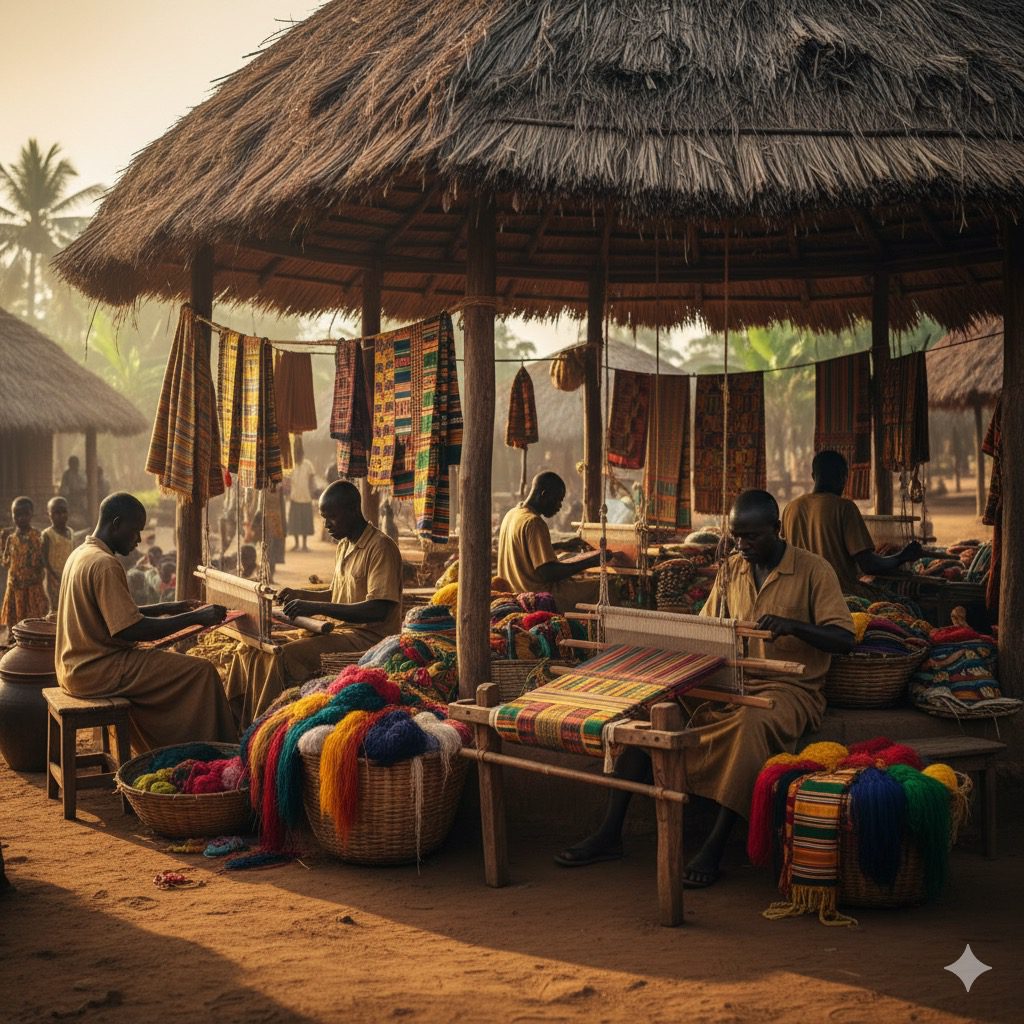
There is a man sitting at a loom in Bonwire, Ghana. He is not young. His hands move with the unhurried certainty of someone who has performed this motion ten thousand times before, and who knows he will perform it ten thousand times again. He does not look up when visitors pass. He does not pause to explain what he is doing or why. The work is its own explanation. The cloth growing beneath his hands has been growing, in one form or another, for centuries. He is simply the latest in a line so long it disappears into the mist of Ghanaian antiquity.
This man is a Kente weaver. And in all likelihood, you have never heard his name.
That is not an accident. It is, in many ways, a reflection of how the weavers themselves have always understood their role. From the earliest days of Kente’s history among the Ewe and Ashanti people of Ghana, the weavers who created this magnificent textile did not position themselves as artists seeking recognition. They positioned themselves as servants of something larger: their communities, their traditions, their ancestors, and their God. The cloth was the point. The weaver was the instrument.
But we live in a different age now. And that difference carries with it a responsibility we have not yet fully accepted.
Ancient Hands, Ancient Humility
The story of Kente weaving as told by Ashanti oral tradition begins not with a master craftsman announcing his genius to the world, but with two young men watching a spider. Observing the web of Anansi with quiet attention, they attempted to replicate its structure using fibres from a palm tree. What they created, they brought not to a market to sell, but to their king, Asantehene Osei Tutu I, as an offering. They did not seek fame. They sought to honour.
This founding act of humility set the tone for everything that followed. For generations upon generations, Kente weavers in the communities of Bonwire and Adanwomase in the Ashanti Region, and in the Ewe weaving towns of Kpetoe and Agotime in the Volta Region, have practised their craft with the same quiet devotion. They learned at their fathers’ feet, or their uncles’, sitting beside the narrow-band loom as children, learning to read the patterns before they could produce them, memorising meanings before their hands were strong enough to weave.
The Weight of What They Carry
To appreciate what these weavers do, it is important to understand the technical and intellectual demands of the craft. Kente weaving is not simple work. It is not the kind of skill acquired in a weekend course or mastered through casual repetition. It is a discipline that demands years of dedicated study, an encyclopaedic knowledge of hundreds of distinct patterns and their meanings, and a physical dexterity that must be built slowly and maintained constantly.
The traditional narrow-band loom on which Kente is woven produces strips of cloth roughly four inches wide. These strips are then cut and sewn together with extraordinary precision to create the full cloth, ensuring that patterns align perfectly across every seam. A master weaver working on a complex commission may spend weeks on a single cloth, holding in their mind simultaneously the full visual design, the symbolic meaning of each section, and the technical requirements of the loom.
The patterns themselves are a form of intellectual property, passed down through lineages with the same care as land or gold. Some patterns belong to specific families and may only be woven by their members. Others are reserved for royalty and may only be commissioned by chiefs and kings. A weaver who produces a reserved pattern without authorisation does not simply make a mistake. They commit a cultural transgression.
What Has Changed, and What It Demands of Us
For most of Kente’s history, the invisibility of the weaver was simply the way things were. Information moved slowly. Communities were smaller. The weaver was known in their village, respected in their town, honoured by the chiefs who commissioned their work. That local recognition, though it never extended to global fame, was sufficient within its context.
That context has changed completely. We live now in a world of unprecedented connectivity. A photograph taken in Bonwire this morning can be seen in London, Lagos, and Los Angeles before nightfall. The same global visibility that has allowed Kente to become one of the most recognised textiles on earth has also created a profound imbalance. The cloth is celebrated everywhere. The people who make it are celebrated almost nowhere.
Exercising Good Judgment: How to Honour the Weavers
Name them. When Kente is featured in a publication, a fashion spread, an academic paper, or a social media post, name the weaving community it came from. Name the town. If possible, name the weaver. A cloth attributed to its source is a cloth that carries dignity.
Seek out authentic work. Every purchase of genuine, handwoven Kente from an Ewe or Ashanti weaver is a vote cast for the continuation of the tradition. Every purchase of a machine-made imitation is a vote cast against it.
Amplify their stories. The weavers of Bonwire and Kpetoe and Adanwomase have stories worth telling. There are elderly masters who carry in their minds patterns that exist nowhere else. There are young weavers who have chosen the loom over other paths, committing to a tradition that the modern world constantly tempts them to abandon.
Support institutional recognition. The Kente Registry and similar initiatives represent the kind of structural change that can embed the weavers’ contribution into the legal and cultural record permanently.
The Loom Is Still Running
Somewhere in Ghana right now, a Kente weaver is at work. The shuttle moves. The patterns accumulate, strip by strip, colour by colour, meaning by meaning. The cloth that will emerge from that loom will go on to mark a birth, or a marriage, or a funeral, or a graduation. It will be photographed and admired and worn with pride. It will travel, perhaps, to another continent entirely, where someone will see it and feel something stir in them, some recognition of beauty and depth that transcends the distance between where they stand and where it was made.
The weaver will not be in that photograph. Their name will likely not appear in the caption. But their hands will be in every thread, their knowledge in every pattern, their devotion in every colour.
It is time the world learned to see them. The greatest artistry is often the quietest. The Kente weavers of Ghana have known this for centuries. Now it is our turn to know it too.